

Latest update
License Price
OS
Aedes.SAV is a software for the analysis and safety checks of arches, vaults and masonry bridges based on the principles of limit analysis. The software allows the static evaluation of vaulted systems also considering any reinforcement interventions and with particular attention to seismic safety checks .
The calculations comply with the current technical regulations (DM 17.1.2018 and related Circular 2019, PCM Directive 9.2.2011 on assessment and seismic risk of cultural heritage, CNR-DT 213/2015: Instructions for the assessment of the structural safety of road bridges in masonry).
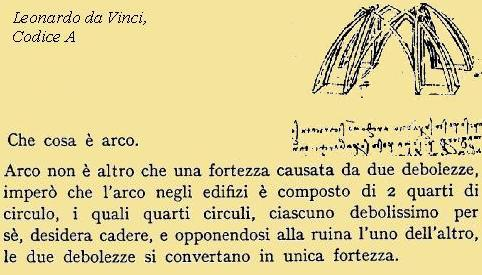
The analysis methodology was developed by the Department of Construction of the University of Florence, Faculty of Architecture, authors: Prof. Arch. Michele Paradiso and Prof. Arch. Giacomo Tempesta, and is based on the studies of Jacques Heyman , in agreement with the most advanced research in the sector and supported by experimental investigations. In subsequent versions, the research and development activities of Aedes Software, managed by Eng. Francesco Pugi, have extended the original field of application . The following have been developed: seismic analysis with vulnerability assessment according to the new generation regulations (DM 2018: seismic risk indicators); the analysis of the effects of settlementsto horizontal and/or vertical shutters; the analysis and safety verification of masonry bridges.
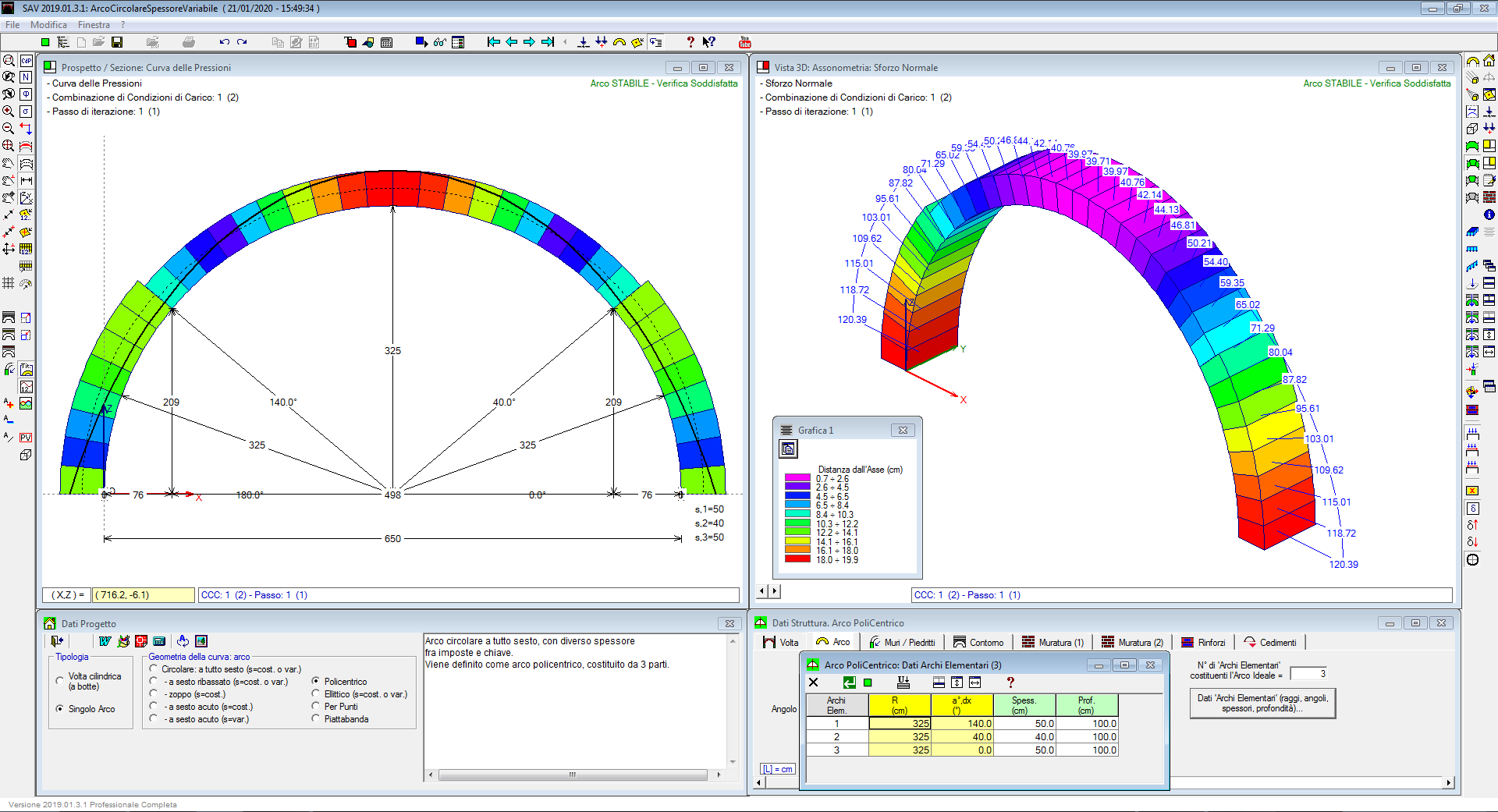
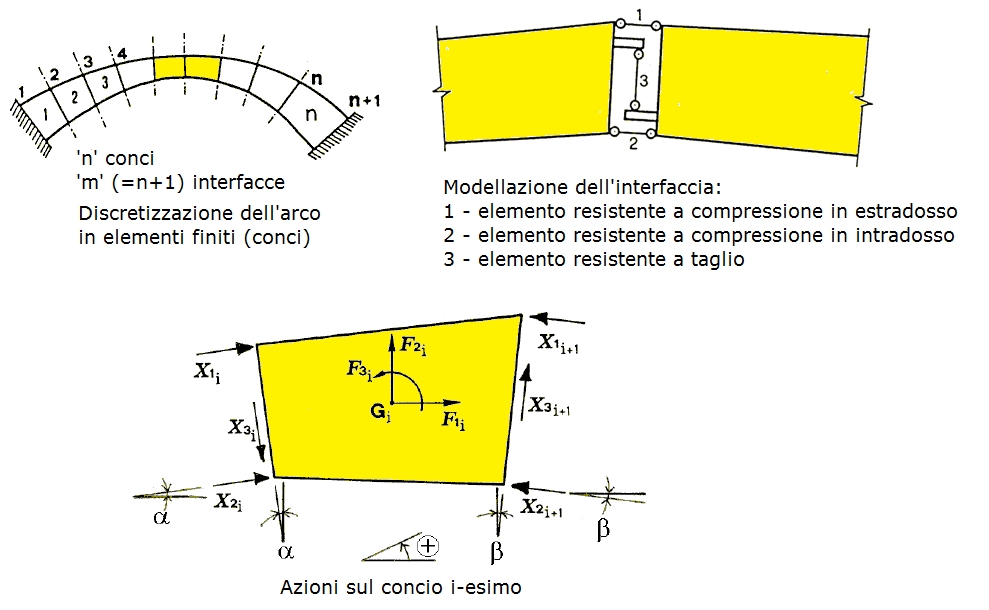
The arched structure is studied considering it to be composed of rigid components, the segments, capable of transmitting only compressive forces through the interfaces. In this way, an overall equilibrium relationship is written, and among the infinite solutions we look for the existence of at least one compatible with the boundary conditions (pressure curve internal to the shape of the arch): if it exists, the arch is stable .
If during the analysis the equilibrium conditions cause the pressure curve to deviate from the geometry of the arch in a section, a hinge is introduced which determines the tangency of the curve (in the intrados or extrados, depending on the case).
By iterative steps it is therefore possible to search for an equilibrium condition compatible with the absence of tractions in the masonry .
If the hinges are introduced in such a number as to determine the formation of a kinematic mechanism (collapse mechanism) or more generally they cannot guarantee a pressure curve in equilibrium with the loads, the arch is unstable and therefore the safety control, under the action of the applied loads, is not satisfied.
The result is an independence of the calculation from the presumed elasticity modules of the masonry: the verification is of a geometric type, within the scope of the graphic statics which has always guided the conception and creation of these structural typologies.
The synergy between the correct setting of these structures (rigid-brittle elements) and the modern finite element method frees us from the need to presuppose symmetrical schemes or those subject to predetermined loads or with cracking positions (hinges) defined a priori (as for example in Méry’s method), thus allowing a generalized analysis which also leads to collapse multipliers for vertical loads and horizontal actions. This last opportunity is directly linked to the seismic analysis of the structure.
Following an approach common to the various sectors of structural analysis, the loads (surface, linear and concentrated, variously arranged on the extrados of the vault flooring) are defined in Elementary Load Conditions (CCE), and for each load it is possible associate the multiplier effect in the vertical or horizontal direction.
CCEs are combined into Load Condition Combinations (CCCs); running the analysis resolves all the CCCs in a single instance, and performs the calculation of the collapse multipliers if required. Collapse multipliers
concern both vertical loads, to determine the maximum value compatible with safety, both the horizontals: this is the case of the seismic capacity , i.e. the multiplier that marks the crisis of the structure (with instability and possible activation of the collapse mechanism).
The seismic analysis can be performed also considering the vertical seismic component . The corresponding forces can refer to 100% or 30% of the effects, with forces arranged upwards, downwards or dependent on the kinematics. The different hypotheses correspond to possible combinations of physical contemporaneity between horizontal and vertical actions. The calculation methodology considers that in the calculation of the capacity, the demand is inserted through the vertical forces and therefore an appropriate iterative procedure determines a coherent result in relation to the seismic collapse multiplier.
Price: 385 $
Price Currency: $
Operating System: Windows
Application Category: Construction
Latest update
License Price
OS


Reviews
There are no reviews yet.