

Latest update
License Price
OS
Amsterdam Modeling Suite (AMS) is a complete computational chemistry suite of molecular modeling and quantum computing tools for analyzing and predicting the properties of molecules and materials. Developed by SCM (Scientific Computing & Modelling), it was previously known as ADF and is considered one of the leading quantum computing software used in the chemical, materials, petroleum, polymer, pharmaceutical, and other scientific and industrial fields.
The Amsterdam Modeling Suite software uses various methods, including density functional theory (DFT), coupled quantum calculations, and molecular mechanics to model molecular systems and various materials. AMS also has capabilities such as modeling large and complex structures, spectroscopic calculations, and interaction with many other chemistry software.
The software features a user-friendly interface that allows users to manage and perform quantum computations with minimal effort. In addition, AMS provides a powerful environment for leading-edge research in various scientific and industrial fields by leveraging advanced computing capabilities and high performance.
Amsterdam Modeling Suite (AMS) is a suite of computational software used to model and simulate molecular structures and material properties. AMS is developed by Synopsys and provides extensive capabilities in the fields of quantum chemistry, physical chemistry, and materials science.
The Amsterdam Modeling Suite (AMS) software has a user-friendly interface that allows users to manage and perform quantum calculations with minimal effort. This interface includes a powerful graphical environment where users can easily build and configure their desired models and systems using graphical tools. Users can also use the command line to perform calculations and access the software’s command line commands.
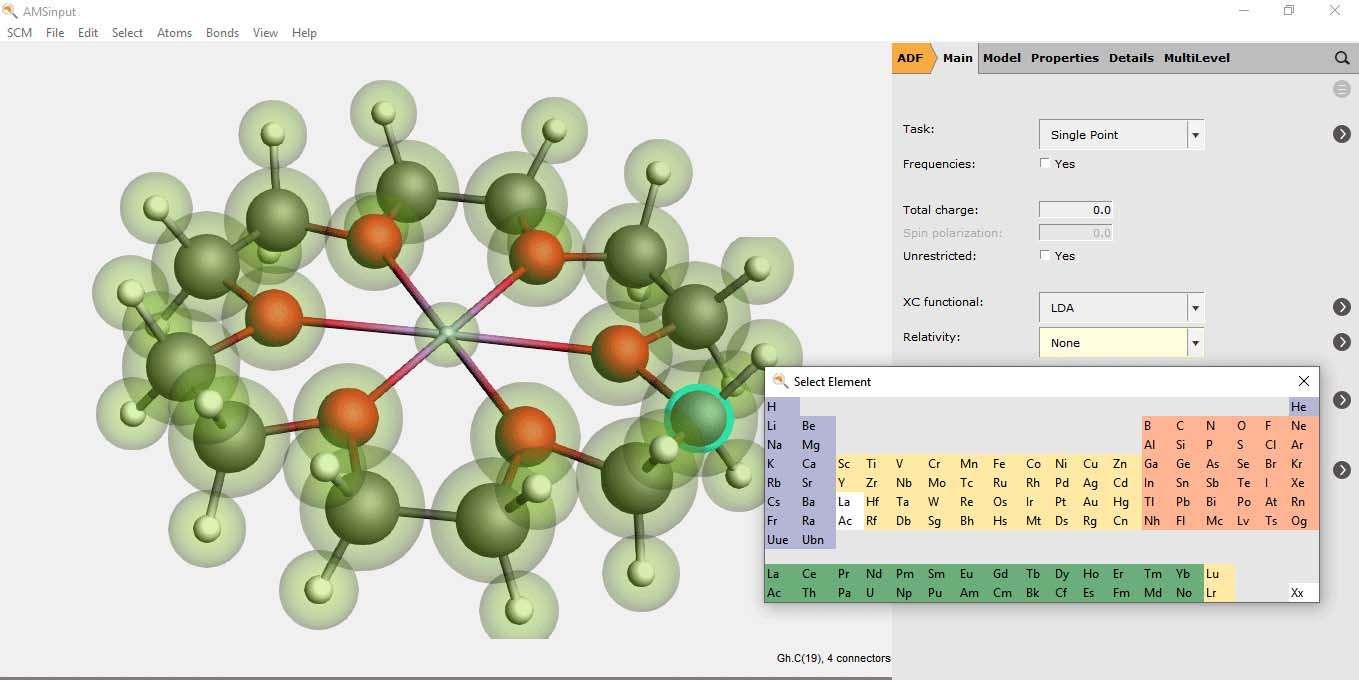
In addition, Amsterdam Modeling Suite is interoperable with many other chemistry software. This feature allows users to transfer the results of calculations to other chemistry and modeling software and use the combination of these software for more extensive and detailed analysis and review of their results.
AMS software has a set of different computational modules, including:
Amsterdam Modeling Suite (AMS) is a leading software package in the field of quantum computing and molecular modeling. AMS uses advanced algorithms that provide the ability to model large and complex systems with high accuracy. The software uses various methods, including density functional theory (DFT), coupled quantum calculations, and molecular mechanics, to model and simulate various molecules and systems.
One of the unique features of the Amsterdam Modeling Suite is the ability to model the behavior of molecules in chemical reactions and dynamic processes using the ReaxFF package. This package allows for the accurate modeling of complex chemical reactions by defining reaction parameters and effective forces between atoms.
The Amsterdam Modeling Suite also uses approximation techniques; for example, using the MOPAC package for fast and low-cost calculations of molecules using molecular transformation functional theory methods (Semi-Empirical Methods) can help users quickly obtain approximate results.
Amsterdam Modeling Suite has unique capabilities that allow users to model and simulate a variety of systems, including materials, nanoparticles, contaminants, biological materials, polymers, and metals. AMS also provides capabilities for analyzing and interpreting computational data, allowing users to gain more insight into the systems they study.
In the Amsterdam Modeling Suite, a large number of computational methods and algorithms are available for various investigations. This includes density functional theory (DFT) calculations with various methods, calculations of continuum theory methods. Also, the software allows the use of some quantum coupled methods such as continuum theory, core-electron models, and density-field models.
One of the unique features of the Amsterdam Modeling Suite is the ability to combine different methods to optimize results. For example, DFT can be combined with molecular dynamics (QM/MM) prediction methods. This allows researchers to model complex reactions and processes with greater accuracy.
Amsterdam Modeling Suite also has numerous capabilities for modeling and analyzing various properties of molecules and materials. For example, AMS is able to model and calculate electronic properties (such as energies of states and wave functions), mechanical properties (such as elastic modulus and stress-strain), electrochemical properties (such as electrochemical dissolution and standard potential), and optical properties (such as electron absorption and transfer).
Amsterdam Modeling Suite also has extensive facilities for analyzing and analyzing computational results data. Various tools can be used to generate graphs, perform statistical analyses, and interpret computational results.
Amsterdam Modeling Suite is a complete and integrated software that supports a wide range of models and computational methods. These models include density functional theory (DFT), limited density functional theory (LDA), and generalized density functional theory (GGA), which are popular computational methods in quantum chemistry. AMS is also capable of using hybrid methods such as B3LYP and PBE0, and correlation-corrected density functional methods such as M06.
To analyze the optical properties of molecules and materials, AMS uses computational methods such as TD-DFT (density functional theory with first-order functionals), which can model the electron absorption and transfer properties of molecules relatively accurately.
To calculate the thermal and electrochemical properties of molecules and materials in different environments, AMS uses models based on solving Poisson’s equations, point-joining methods models, and coupled quantum-molecular mechanics (QM/MM) models. This allows researchers to model different properties of molecules in different environments and gain more information about their behavior in real environments.
The Amsterdam Modeling Suite also uses models of the behavior of molecules at different temperatures and pressures, and modeling of catalyst reactions in the presence of different environments. These features allow users to study and optimize chemical reactions more accurately and practically.
Using the Amsterdam Modeling Suite, users can model a variety of systems, including large molecular systems, proteins, nanoparticles, complex chemical reactions, and material interfaces. AMS allows for accurate calculations of the thermodynamics and kinetics of reactions, and this information is very useful for the design of drugs, catalysts, polymeric materials, and catalytic activities.
The Amsterdam Modeling Suite features include the ability to predict electronic and optical properties of molecules, such as energies of states, absorption wavelengths, and light absorption coefficients. AMS also allows for the analysis of electrochemical properties of molecules, such as standard potentials and redox potentials, which are used to investigate important electrochemical processes.
In the Amsterdam Modeling Suite, Poisson equation solving models can be used to calculate the properties of molecules in different environments. AMS also allows users to model catalyst reactions in the presence of different environments, which is very valuable for improving catalysts and increasing reaction efficiency.
The Amsterdam Modeling Suite software provides a variety of capabilities for analyzing computational data. These capabilities include generating graphs, statistical analysis, calculating structural properties, and interpreting computational results. These capabilities allow researchers to better interpret computational results and achieve greater accuracy in modeling systems.
By combining these capabilities and features, Amsterdam Modeling Suite allows researchers in various scientific fields to choose the best approaches for modeling and analyzing molecules and materials. This software is known as a powerful and integrated tool in the field of quantum chemistry and molecular modeling and is very useful in various scientific and industrial research and applications.
Price: 600 $
Price Currency: $
Operating System: Windows
Application Category: Computational Chemistry
Latest update
License Price
OS










Reviews
There are no reviews yet.