
CivilFEM 2025 for ANSYS is a specialized civil engineering environment built on top of ANSYS Mechanical, adding industry-specific tools, materials, load types, and code-checking capabilities tailored for civil infrastructure projects. It transforms general-purpose ANSYS into a civil engineering-focused platform with pre-configured workflows for concrete design, steel structures, geotechnics, bridges, and nonlinear analysis. CivilFEM maintains full compatibility with ANSYS Workbench while adding hundreds of civil-specific features.
CivilFEM 2025 supports several versions of ANSYS. “CivilFEM 2025 for ANSYS” can run with ANSYS 2025, as well as older versions of ANSYS (2020, 2021, 2022, 2023, 2024 and 2025).
CivilFEM targets civil engineering specialists within the ANSYS ecosystem:
Structural Engineers analyzing buildings, bridges, towers, and industrial structures
Geotechnical Engineers performing soil-structure interaction, tunneling, and foundation analysis
Bridge Designers designing and verifying bridge structures to international codes
Nuclear & Energy Engineers analyzing containment structures and power plant components
Construction Engineers simulating construction sequences and temporary works
Academic & Research Institutions teaching advanced FEA in civil engineering contexts
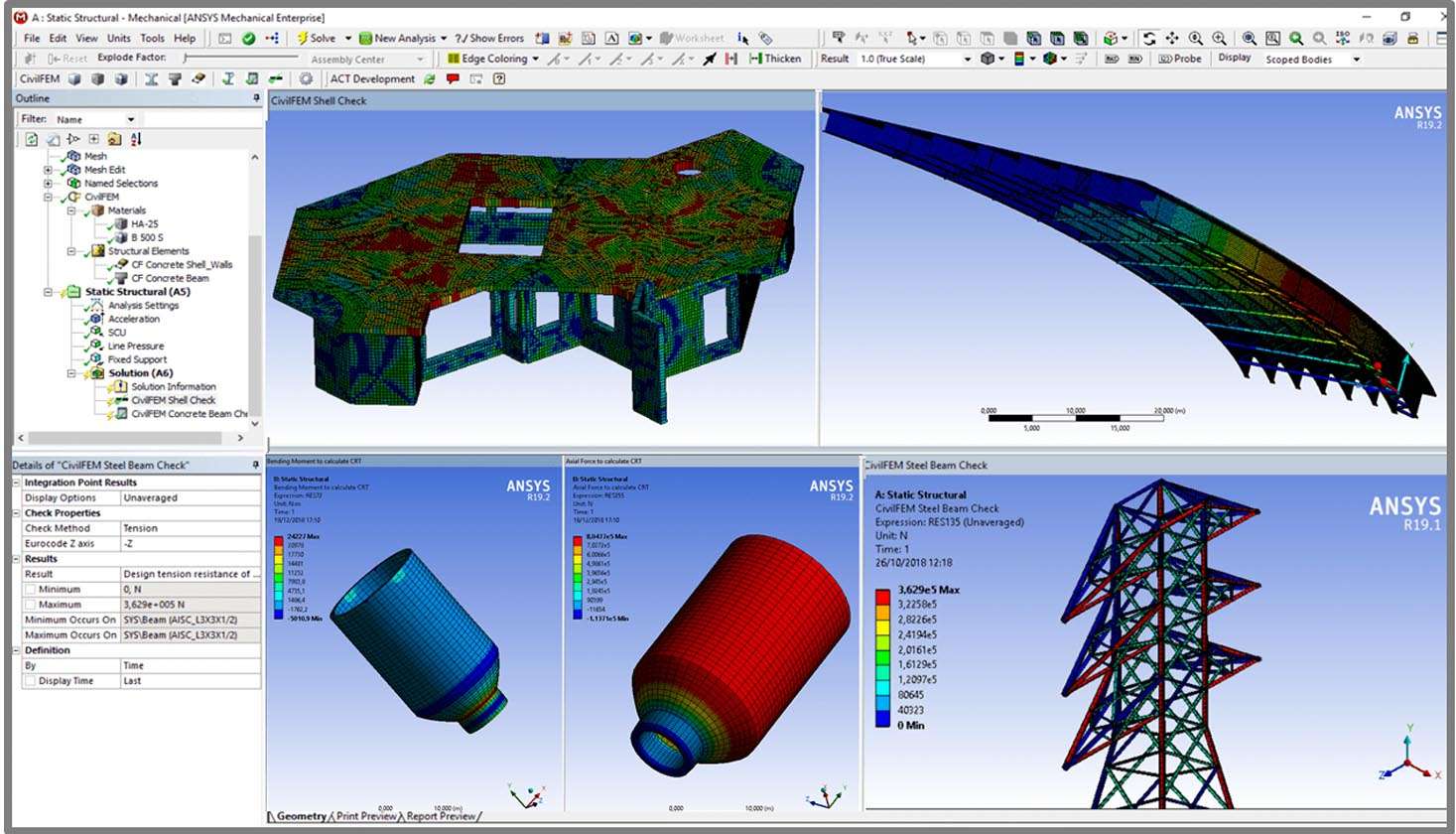
Reinforced Concrete Design: Automated reinforcement design per ACI 318, Eurocode 2, and other international codes
Steel Structure Design: Code checking per AISC, Eurocode 3, with connection design tools
Geotechnical Analysis: Advanced soil models, pile foundations, retaining walls, and slope stability
Bridge Analysis: Construction stages, prestressing, cable-stayed, and suspension bridge tools
Dynamic Analysis: Seismic analysis with response spectra, time history, and pushover analysis
Workbench Native Interface: Full integration within ANSYS Workbench environment
Extended Material Library: 500+ civil engineering materials (concrete grades, soils, composites)
Specialized Load Types: Construction sequence loads, thermal gradients, settlement loads
Advanced Element Types: Beam, shell, and solid elements optimized for civil structures
Automated Reporting: Code-compliant calculation reports with engineering drawings
Nonlinear Analysis: Concrete cracking, crushing, reinforcement yielding, and soil plasticity
Construction Stage Analysis: Sequential activation/deactivation of elements and loads
Prestressing Analysis: Post-tensioned and pre-tensioned concrete simulation
Fatigue Assessment: For bridges and industrial structures under cyclic loading
Buckling Analysis: Linear and nonlinear buckling for slender structures
AI-Powered Reinforcement Optimization: Machine learning suggests optimal rebar layouts and quantities, reducing material use by 10-20%
Digital Twin Integration: Direct connection to IoT sensor data for real-time model updating and condition assessment
BIM Interoperability: Enhanced IFC 4.3 import/export with Revit, Tekla, and ArchiCAD bidirectional links
Climate Load Generator: Automated climate loading (temperature, wind, snow) based on geographic location and climate models
3D Printing Readiness: Analysis tools for 3D-printed concrete structures with layer adhesion modeling
2025 Code Implementations: Latest ACI 318-24, Eurocode 2024 updates, and ASCE 7-22 seismic provisions
Sustainability Assessment: Embodied carbon calculation and optimization during design phase
Seismic Performance Design: Enhanced tools for Performance-Based Earthquake Engineering (PBEE)
Bridge Lifecycle Analysis: Corrosion modeling and durability assessment for bridge structures
GPU-Accelerated Solvers: NVIDIA CUDA support for faster nonlinear analysis (2-4x speedup)
Cloud Computation: Seamless cloud solving integration with ANSYS Cloud and major cloud providers
Automated Model Checking: AI-driven model validation detecting common modeling errors
Enhanced Visualization: VR/AR ready outputs for immersive design reviews
Minimum Requirements:
OS: Windows 10 Pro 64-bit (21H2) or Windows 11 Pro
ANSYS Version: ANSYS 2024 R2 or 2025 R1 (must match CivilFEM version)
CPU: Intel Core i7-11700 or AMD Ryzen 7 5700X (8 cores)
RAM: 32 GB (64 GB recommended for large models)
GPU: NVIDIA Quadro RTX 4000 or GeForce RTX 3070 (8 GB VRAM)
Storage: 100 GB free SSD space + 500 GB for projects
Display: 1920×1200 minimum
Recommended Configuration:
OS: Windows 11 Pro for Workstations
ANSYS: 2025 R1 with HPC licenses
CPU: Intel Core i9-14900K or AMD Ryzen 9 7950X (24 threads)
RAM: 128 GB DDR5 (256 GB for complex geotechnical models)
GPU: NVIDIA RTX A5500 (24 GB VRAM) or RTX 4090
Storage: 1 TB NVMe Gen4 SSD + 2 TB SSD project storage
Network: 2.5 GbE for license/cloud access
Price: 325 $
Price Currency: $
Operating System: Windows
Application Category: Civil Engineering




Reviews
There are no reviews yet.