
Synopsys CODE V is the world’s leading optical engineering software for the design, analysis, and optimization of high-performance imaging optical systems. Renowned for its powerful global optimization algorithms and precision ray tracing, it enables engineers to push the boundaries of what’s physically possible in lens design. CODE V excels at solving complex, multi-configuration problems—such as zoom lenses, scanning systems, and systems with moving elements—while simultaneously optimizing for manufacturing tolerances and thermal effects. It is the standard tool for developing cutting-edge optics where diffraction-limited performance, compact packaging, and manufacturability are critical.
This industry-leading optical design software is designed for:
Lens Designers & Optical Engineers creating high-performance imaging systems (cameras, microscopes, telescopes).
R&D Engineers in aerospace/defense developing reconnaissance, targeting, and IR imaging systems.
Automotive Camera System Engineers designing ADAS, LiDAR, and in-cabin monitoring optics.
Medical Imaging Specialists developing endoscopes, ophthalmic devices, and diagnostic optics.
Consumer Electronics Teams designing smartphone cameras, VR/AR optics, and projection systems.
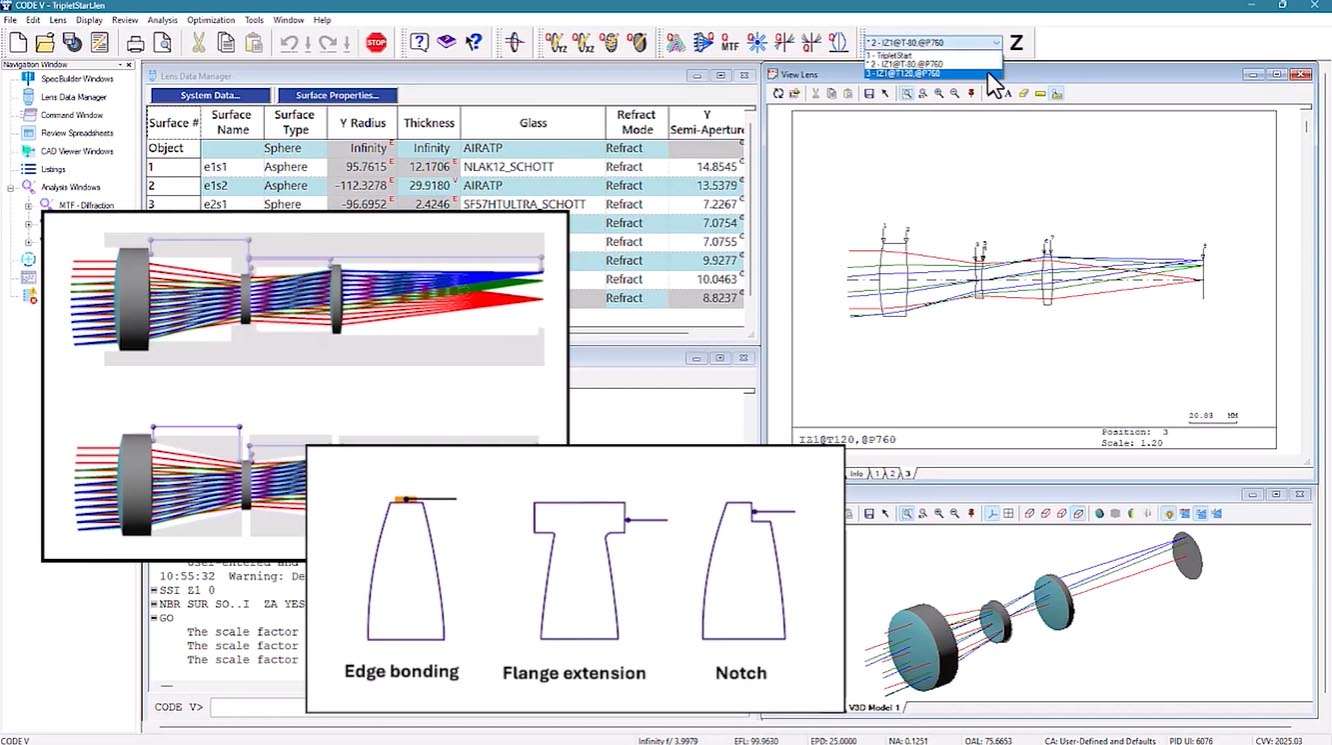
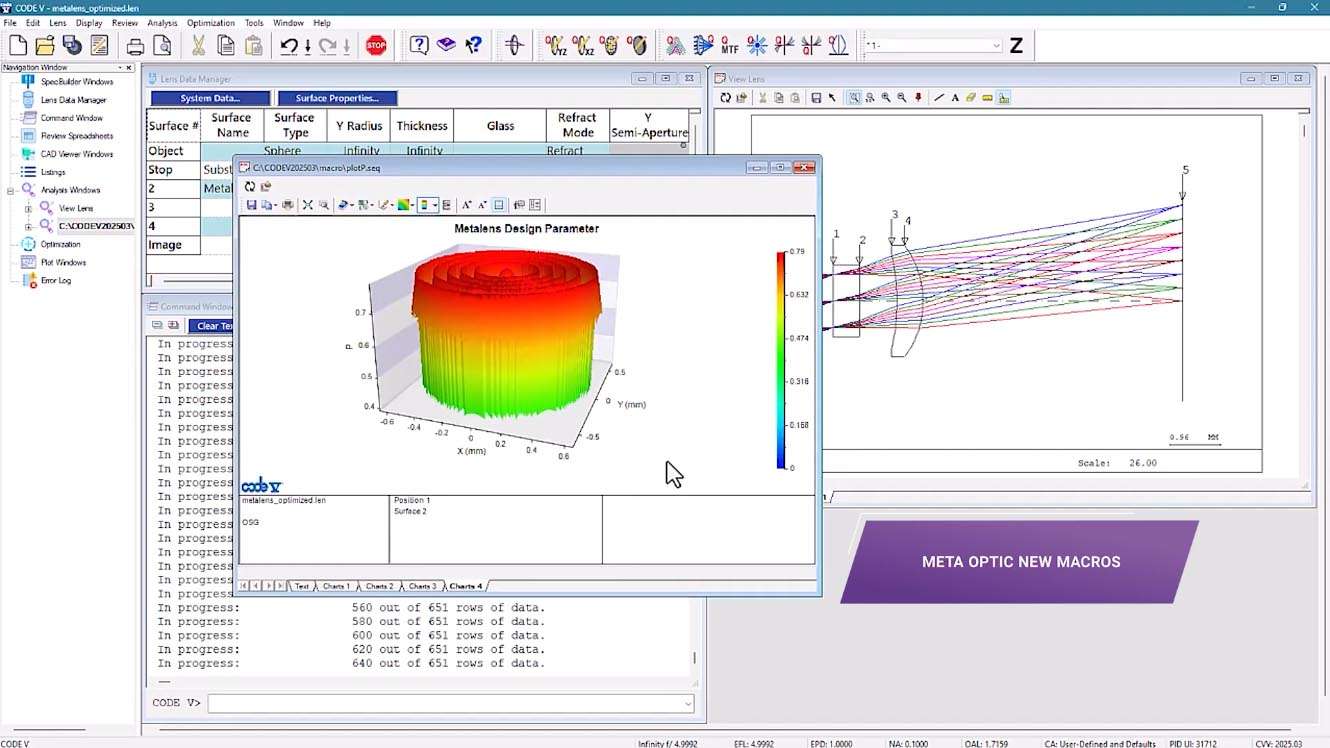
Global Synthesis & Optimization: Industry-unique global optimization algorithms (e.g., Adaptive Synthesis) to automatically find novel, high-performance lens starting points from specifications.
Tolerancing & Yield Analysis: Comprehensive tools to analyze manufacturing sensitivities and predict as-built performance and production yield.
Diffraction-Limited Analysis: Advanced physical optics propagation (POP) for modeling laser systems, Gaussian beams, and coherent imaging.
Multi-Configuration & Zoom Design: Native support for systems with moving groups, multiple object positions, and zoom configurations.
Thermal & Environmental Analysis: Integrated analysis of optical performance across temperature ranges and mechanical deformations.
Advanced Modeling: Support for gradient-index (GRIN) materials, diffractive optical elements (DOE), freeform surfaces, and polarization.
Enhanced Freeform Design Capabilities: New optimization constraints and analysis tools specifically tailored for complex freeform surface optics in AR/VR and automotive applications.
AI-Assisted Optimization Guidance: Machine learning algorithms suggest promising optimization pathways and variable selections based on the design form.
Streamlined Interface for Common Tasks: Redesigned workflows for tolerance sensitivity analysis and multi-configuration management.
Expanded Material Catalogs: Updated database including latest glass types from Schott, Ohara, and Hoya, and infrared materials.
Improved Interoperability: Enhanced data exchange with Synopsys LightTools and RSoft Photonic Device Tools for integrated opto-mechanical and photonic design flows.
OS: Windows 10/11 Pro
RAM: 16 GB minimum (32 GB+ for large optimization tasks)
CPU: Multi-core Intel Xeon or AMD EPYC (high single-core speed critical for optimization)
Price: 325 $
Price Currency: $
Operating System: Windows
Application Category: Optics






Reviews
There are no reviews yet.