
Gamma Technologies GT-SUITE is a leading multi-physics, system-level simulation software built on a 1D/Quasi-3D approach. It enables engineers to model the transient behavior of complex systems involving fluid flow, thermodynamics, mechanics, chemistry, and electromagnetics. Unlike 3D CFD/FEA tools that focus on detailed component analysis, GT-SUITE excels at simulating the entire system interaction throughout an operating cycle (e.g., a full vehicle drive cycle). It is built on a lumped parameter methodology with embedded 3D capabilities, offering an unmatched balance between simulation speed and fidelity for system design, control strategy development, and performance prediction.
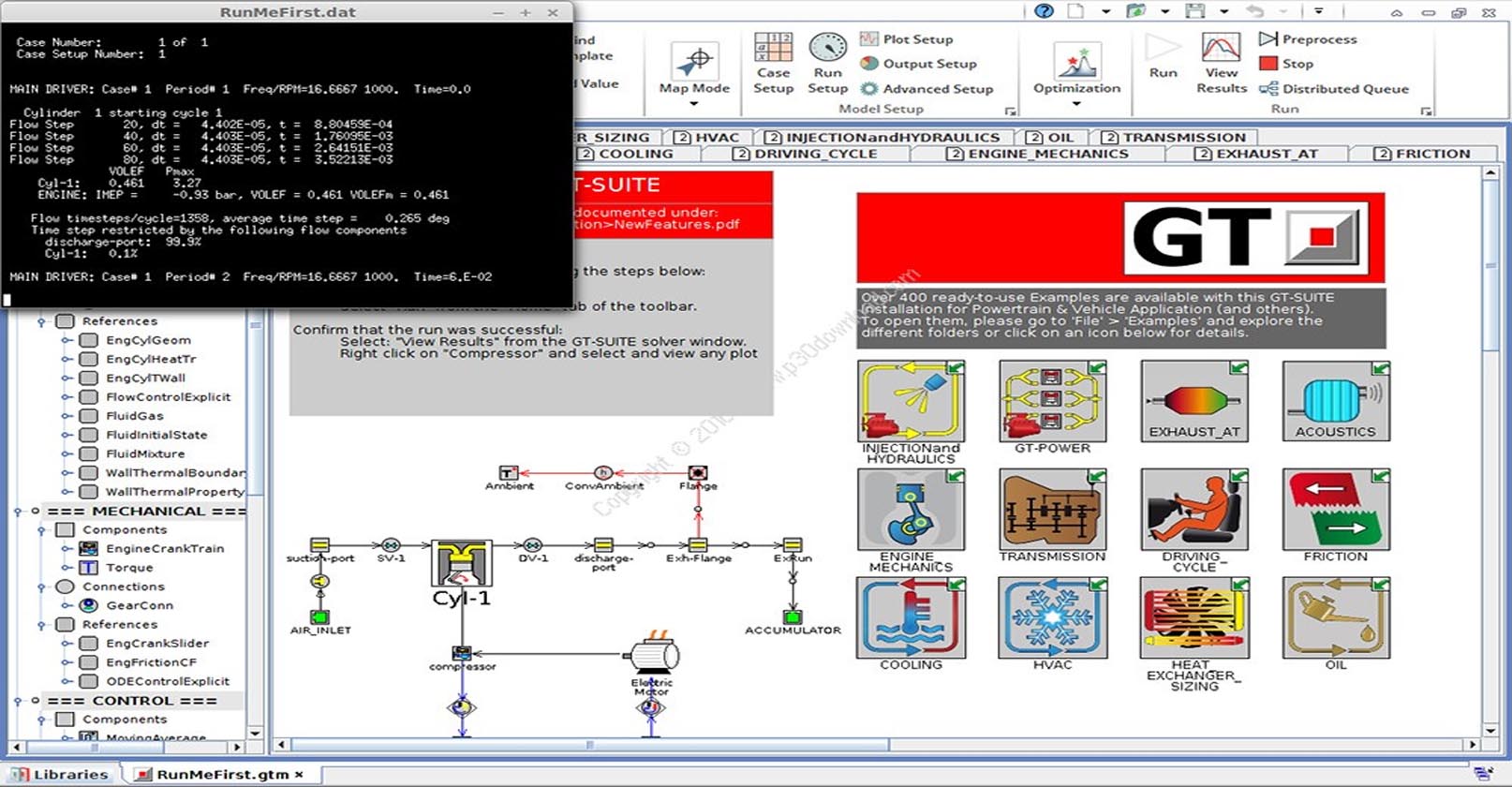
Powertrain Simulation (GT-POWER): Industry-standard for ICE modeling. Includes detailed combustion (DI, SI), gas exchange, turbocharging, and engine performance mapping.
Electrified Vehicle Suite (GT-DRIVE+): Complete vehicle simulation for HEV/BEV, including motor/inverter efficiency maps, battery electro-thermal models, and energy management strategy optimization.
Thermal Management Systems (GT-COOL): Model complex coolant, refrigerant (A/C), and oil circuits with two-phase flow, coupled to 3D thermal structures (e.g., battery packs).
Acoustics & Fluid Dynamics (GT-SUITE Core): Predict pressure pulsations, flow-generated noise, and wave dynamics in intake/exhaust, piping, and manifolds.
Battery & Fuel Cell Modeling: Dedicated libraries for Li-ion battery electro-thermal-aging and PEM fuel cell stack performance.
Co-Simulation & Controls: Native integration with MATLAB/Simulink for controls development, and with 3D CAE tools (Star-CCM+, CONVERGE, Ansys) for detailed component coupling.
Optimization & DOE: Built-in tools (HEEDS) for design space exploration, multi-objective optimization, and robust design.
Real-Time Capabilities (GT-RT): Generate real-time capable models for HIL (Hardware-in-the-Loop) testing.
3D Submodels & CAD Import: Embed 3D finite-volume or finite-element submodels (e.g., for detailed fluid volumes or structural parts) directly within the 1D system context.
The 2025.2 release emphasizes AI integration, sustainability, and enhanced electrification workflows:
AI-Assisted Model Building & Calibration (GT-AI): New machine learning module that suggests component connections, auto-tunes model parameters to match test data, and identifies optimal sensor placements for virtual sensing.
Enhanced e-Fuel & Hydrogen Combustion Models: Expanded chemical kinetics libraries for sustainable fuels (e-methanol, e-diesel, H2) and updated combustion models (CCM) for hydrogen ICE simulation.
Digital Twin Deployment Suite (GT-TWIN): New toolkit for packaging validated system models into lightweight, runtime-optimized formats for deployment in cloud-based digital twin platforms and edge devices.
Battery Degradation & Second-Life Analysis: Advanced aging models that predict capacity fade under real-world usage profiles and simulate performance in second-life (stationary storage) applications.
Extended System-of-Systems Modeling: Improved capabilities for simulating vehicle-to-grid (V2G) interactions and complex energy networks (microgrids with renewables, generators, and storage).
Usability & Performance: Faster solver kernels (up to 30% speedup for large thermal-fluid systems), and a revamped project management dashboard for tracking multi-run studies.
OS: Windows 10 Pro 64-bit (21H2) or RHEL 8.6 Linux
CPU: Intel Core i7-10700 or AMD Ryzen 7 5700X (8 cores)
RAM: 16 GB (32 GB strongly recommended)
GPU: Dedicated GPU with 2 GB VRAM (for GUI and 3D post-processing)
Storage: 50 GB free space on SSD (plus significant space for simulation results)
Network: Stable connection for license server (FlexNet)
OS: Windows 11 Pro / Windows 10 Pro for Workstations / RHEL 9.2
CPU: Intel Core i9-14900K or AMD Ryzen 9 7950X (High clock speed + high core count). For DOE/Optimization, more cores (e.g., Threadripper/Xeon W) are key.
RAM: 64 GB – 128 GB (Required for large thermal models, full vehicle simulations with high-fidelity components)
GPU: NVIDIA RTX A4000 (16 GB) or GeForce RTX 4080 for advanced visualization and GPU-accelerated post-processing.
Storage: 1 TB NVMe SSD for software and active projects. A fast secondary RAID/NAS for result archiving.
HPC/Cloud: Support for distributed solving on clusters. Cloud-based licensing and solving options available.
Price: 325 $
Price Currency: $
Operating System: Windows
Application Category: Automotive










Reviews
There are no reviews yet.