

Latest update
License Price
OS
The System Design Load (SDL) program calculates design cooling and heating loads for commercial buildings to facilitate HVAC system design. System Design Load advances the art of HVAC load estimating by introducing the concept of system-based design.
System-based design is a technique which considers specific HVAC system features when performing load estimating and system sizing calculations. This is important because many systems have unique features which require special sizing procedures. For example, consider Single Zone CAV, VAV, and Fan Powered Mixing Box systems. All contain different components and operate in different ways. To provide high quality system sizing data, the special features of each must be considered when sizing the system.
This professional multibody dynamics simulation software is designed for:
Mechanical Engineers & Systems Designers analyzing motion, forces, and interactions in complex mechanical systems.
Automotive Engineers simulating vehicle dynamics, suspension systems, and powertrain behavior.
Aerospace Engineers modeling landing gear, deployment mechanisms, and flight control systems.
Robotics Engineers designing and optimizing robotic manipulators and mobile platforms.
Industrial Machinery Designers evaluating heavy equipment, manufacturing systems, and consumer products.
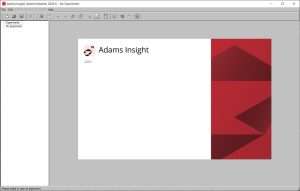
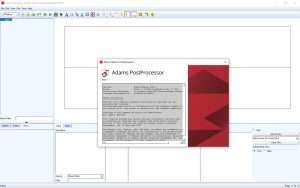
Rigid & Flexible Bodies:
Create rigid bodies with mass and inertia properties
Import flexible bodies from FEA software (Nastran, Abaqus, Ansys)
Coupled rigid-flexible simulations for accurate deformation prediction
Stress and strain analysis during dynamic motion
Assembly & Constraints:
Build complex mechanical assemblies with intuitive modeling tools
Comprehensive joint library: revolute, prismatic, spherical, cylindrical, planar, screw, universal
Higher-pair constraints: cams, gears, couplers, cables
Parametric modeling for design variation studies
Kinematic & Dynamic Analysis:
Time-based simulation of dynamic systems under applied loads
Kinematic analysis for motion envelope and clearance studies
Nonlinear motion simulation with large displacements
Static, quasi-static, and dynamic equilibrium solutions
Contact & Impact Modeling:
2D and 3D contact definitions (point-to-point, curve-to-curve, surface-to-surface)
Friction modeling with static, dynamic, and viscous coefficients
Impact force calculations with penetration-based compliance
Multi-point contact for complex interactions
Passive Elements:
Springs, dampers, bushings with linear/nonlinear characteristics
Beam elements for structural flexibility
Tires, belts, and cables for specialized applications
Active Elements:
Translational and rotational actuators
Motion drivers with displacement, velocity, or acceleration control
Custom force functions via user-defined expressions
Hydraulic and pneumatic actuator modeling
High-Performance Solvers:
Implicit and explicit integration methods
Linear and nonlinear analysis capabilities
Parallel computing support for large-scale simulations
Robust contact algorithms for complex interactions
Analysis Types:
Dynamic simulation
Kinematic analysis
Static equilibrium
Linear modal analysis
Sensitivity studies
Co-Simulation: Seamless integration with control system software (MATLAB/Simulink, Easy5)
Mechatronic Systems: Simulate combined mechanical and control behavior
Embedded Controller Testing: Validate control algorithms with virtual mechanical plants
Feedback Systems: Model sensors, actuators, and closed-loop control
Real-Time 3D Animation: Visualize motion during and after simulation
Result Plotting: X-Y plots of forces, displacements, velocities, accelerations
Data Export: CSV, Excel, and other formats for further analysis
Report Generation: Automated creation of simulation reports
Animation Export: Video files for presentations and documentation
Direct CAD Import: Support for major CAD formats (Parasolid, STEP, IGES, CATIA, NX, SolidWorks, Creo)
Associative Updates: Maintain links to CAD geometry for design changes
Flexible Body Import: MNF (Modal Neutral File) format from FEA solvers
Co-Simulation with FEA: Coupled MBD-FEA analysis for detailed stress prediction
Design Variables: Parameterize model dimensions, properties, and forces
Design of Experiments (DOE): Automated parametric studies
Sensitivity Analysis: Identify critical design parameters
Goal-Driven Optimization: Automatically optimize designs to meet performance targets
Enhanced Flexible Body Solver – Faster and more accurate rigid-flexible coupled simulations
Improved Contact Algorithms – More robust surface-to-surface contact for complex geometries
CAD Interoperability Updates – Expanded support for latest CAD formats (CATIA V6, NX 2306, SolidWorks 2025)
Solver Performance Optimizations – Parallel computing improvements for large-scale models
UI/UX Refinements – Streamlined modeling workflow and improved result visualization
MATLAB/Simulink Integration – Updated co-simulation interface for latest MATLAB releases
New Joint Library Additions – Enhanced cable and pulley modeling capabilities
Post-Processing Enhancements – Additional plotting options and report templates
Licensing Flexibility – Updated network licensing and cloud licensing options
OS: Windows 10/11 (64-bit)
CPU: Multi-core processor
RAM: 8 GB
Storage: 10 GB free space
Graphics: OpenGL-supported graphics card
OS: Windows 10/11 Pro (64-bit)
CPU: Intel Core i7 / Xeon or AMD Ryzen 7 / Threadripper
RAM: 16–32 GB (higher for complex models)
Storage: 20 GB free space + SSD for optimal performance
Graphics: Dedicated NVIDIA Quadro / GeForce or AMD Radeon Pro with 4GB+ VRAM
Price: 125 $
Price Currency: $
Operating System: Windows
Application Category: Mechanical Engineering
Latest update
License Price
OS











Reviews
There are no reviews yet.