
Computherm Pandat is a premier software package for multicomponent phase equilibrium calculations, thermodynamic property modeling, and kinetic simulation. Built upon the powerful PanEngine computational core, it enables researchers and engineers to predict phase diagrams, simulate solidification paths, and calculate thermophysical properties for complex, multi-component systems. By leveraging comprehensive thermodynamic databases (for alloys, oxides, solders, etc.), Pandat accelerates materials design by replacing costly and time-consuming experimental trial-and-error with high-fidelity virtual prototyping. It serves as a critical tool for understanding microstructure formation, optimizing processing parameters, and predicting material behavior under various thermal conditions.
This specialized materials informatics software is designed for:
Materials Scientists & Metallurgists developing new alloys, ceramics, and functional materials.
Computational Thermodynamics Researchers modeling phase equilibria and material properties.
R&D Engineers in aerospace, automotive, and electronics industries for alloy design.
Academics & PhD Students in materials science, physics, and chemical engineering departments.
Process Engineers in casting, welding, heat treatment, and additive manufacturing
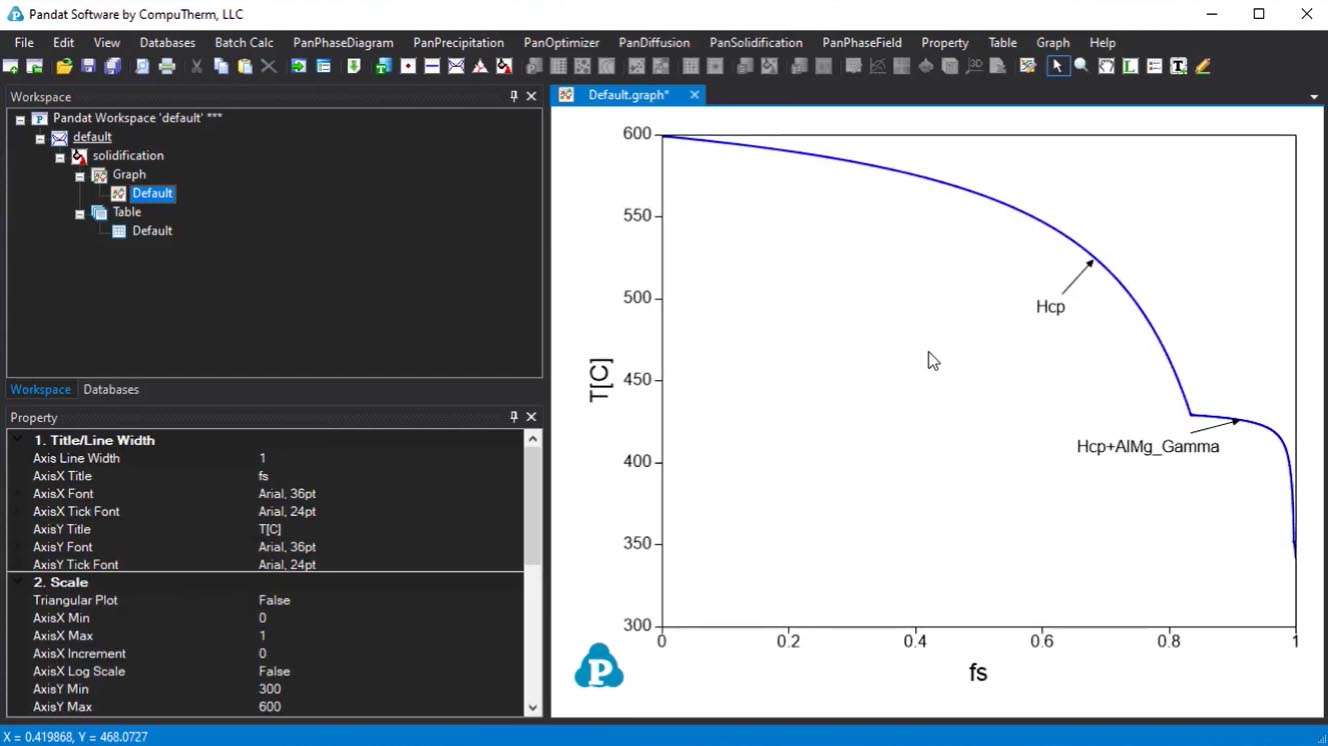
Multicomponent Phase Diagram Calculation: Calculates isothermal, vertical, and property phase diagrams for systems with up to 20+ components.
Solidification & Scheil Simulation: Models non-equilibrium solidification, predicting microsegregation and secondary phase formation.
Thermodynamic Database Management: Works with proprietary (PanDB) and user-developed databases for alloys, solders, oxides, and more.
Property Calculation Module: Predicts thermophysical properties (enthalpy, heat capacity, density) and phase-specific properties (mobility, interfacial energy).
Kinetic Simulation (PanDiffusion/PanPrecipitation): Simulates diffusion-controlled phase transformations and precipitation kinetics (e.g., in Al or Ni-based alloys).
Automated Batch Calculation & API: Enables high-throughput calculation for materials screening and integration into custom workflows via programming interface.
Enhanced Machine Learning Interface: Improved integration for building and deploying ML-based surrogate models for rapid property prediction.
Expanded Additive Manufacturing Module: New tools for simulating rapid solidification and non-equilibrium phase formation relevant to laser powder bed fusion.
High-Entropy Alloys (HEA) Database & Tools: Dedicated database and analysis functions for designing and assessing multi-principal element alloys.
Advanced Visualization & GUI: More intuitive plotting controls, 3D phase diagram visualization enhancements, and streamlined project management.
Performance Optimizations: Faster computation speeds for large-scale kinetic simulations and complex multi-component equilibrium calculations.
OS: Windows 10/11 (64-bit) or Linux (Red Hat, CentOS, Ubuntu)
RAM: 6 GB minimum (16 GB+ recommended for kinetic simulations)
CPU: Multi-core Intel or AMD processor
Storage: 2 GB free space for installation + space for database files
Other: Microsoft .NET Framework 4.8 (for Windows GUI)
Price: 325 $
Price Currency: $
Operating System: Windows
Application Category: Computational Chemistry










Reviews
There are no reviews yet.