
Raceway & Cable Management Software refers to specialized design and documentation tools for planning and modeling cable tray, conduit, busway, and wireway systems. These applications are usually modules within larger electrical CAD or BIM platforms (like AutoCAD Electrical, Revit MEP, or EPLAN) that allow designers to create intelligent 3D/2D layouts of raceway pathways, automatically calculate fill percentages, size trays and conduits per code (NEC, IEC), and generate detailed bills of materials (BOM) and installation drawings. They ensure designs are efficient, code-compliant, and clash-free within coordinated building models.
This software is critical for designing organized, maintainable, and safe cable infrastructure in data centers, industrial facilities, commercial buildings, and transportation projects.
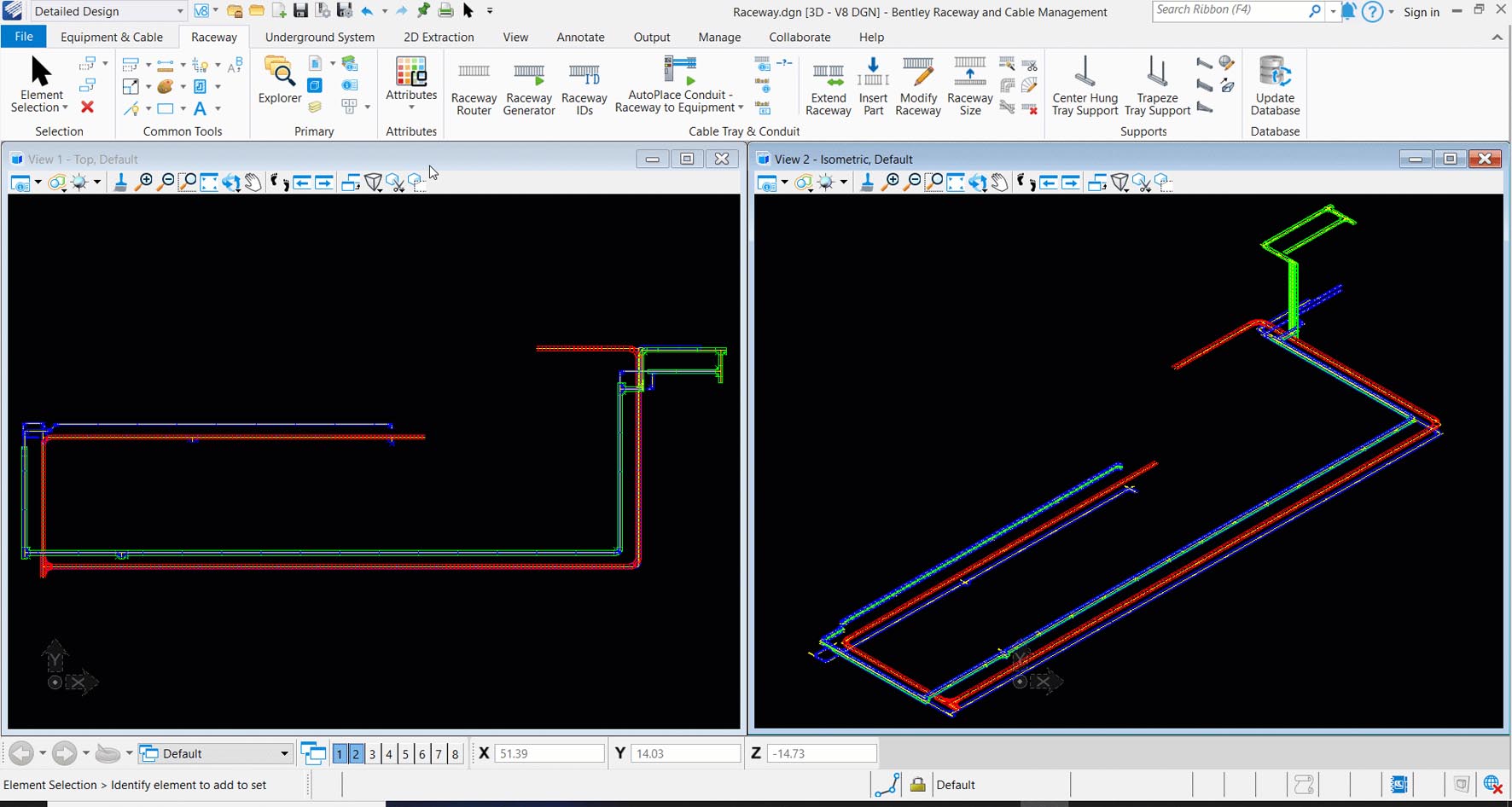
These tools focus on the physical routing and management of cables and their containment systems.
3D Raceway Modeling:
Parametric Raceway Libraries: Extensive libraries of manufacturer-specific or standard cable trays (ladder, trough, channel), conduits (EMT, RMC), busways, and supports.
Intelligent Routing: Tools to draw and modify raceway routes in 3D with automatic fittings (elbows, tees, reducers, risers). Systems understand elevation changes and offsets.
Cable Routing & Management:
Cable Definition: Define cable types (power, data, fiber) with properties (diameter, weight, bend radius).
Automatic/Manual Cable Routing: Route virtual cables through the modeled raceway system. Software can calculate optimal paths and lengths.
Fill Capacity & Jamming Calculations: Automatically calculate the cross-sectional area fill percentage of trays and conduits to ensure NEC/IEC compliance. Check for cable jamming in bends.
Analysis & Reporting:
Clash Detection: Identify interferences between raceway systems and other building services (pipes, ductwork, structure) within a coordinated BIM model.
Voltage Drop & Short Circuit Analysis: Some advanced tools integrate electrical calculations for the routed cables.
Automated Reports: Generate cable schedules, pull lists, bill of materials (BOM) for trays/conduits/fittings, and total cable length reports.
Construction & Fabrication Detailing:
Fabrication Drawings: Generate detailed shop drawings and spool sheets for prefabricated raceway sections.
Isometric & Orthographic Views: Automatically create installation drawings from the 3D model.
Data Centers: High-density tray layouts, underfloor routing, and meticulous pathway planning.
Industrial Plants: Managing complex cable trays for instrumentation and power in oil & gas, chemical, or manufacturing facilities.
Commercial Buildings: Coordinating overhead tray and conduit runs for power, lighting, and telecom.
Requirements are high and dictated by the host CAD/BIM platform. They are generally equivalent to or exceed those for advanced 3D design software.
Minimum System Requirements (General Guideline):
Windows 10/11 (64-bit), a 2.5+ GHz multi-core processor, 16 GB RAM, a dedicated professional graphics card (NVIDIA Quadro/GeForce RTX or AMD Radeon Pro) with 4 GB VRAM, and 50+ GB of free SSD space.
Recommended for Professional 3D Plant/BIM Models:
Windows 10/11 Pro for Workstations, a high-frequency CPU (Intel Core i9/Xeon or AMD Ryzen 9/Threadripper), 32-64 GB RAM, a high-end GPU (NVIDIA RTX A5000/GeForce RTX 4080+), fast NVMe SSD storage, and multiple high-resolution monitors.
Price: 125 $
Price Currency: $
Operating System: Windows
Application Category: Electrical Engineering











Reviews
There are no reviews yet.