
Available versions: 25.3 , 25.1 , 24.2 , 23.2, 22.2 , 21.1 , 20.4 , 20.1.942 , 19.4 , 19.3 , 19.2 , 19.1

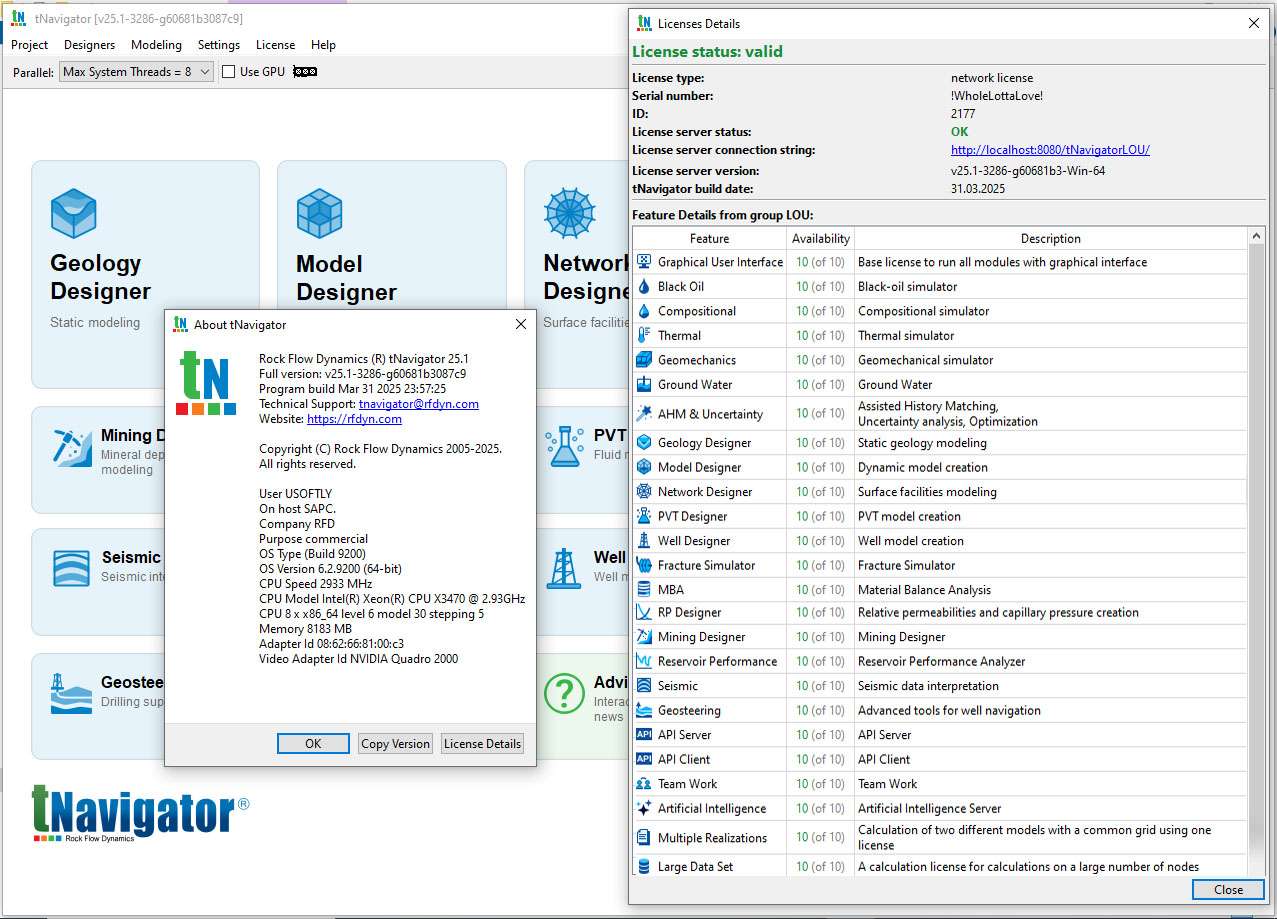


tNavigator is a powerful software for dynamic simulation of oil and gas tanks. This program is a collective effort of RFD researchers and development team. It can be installed on personal systems, laptops, servers and even HPC clusters. The program is written in C ++ and uses the latest parallel processing technologies and hardware accelerators. The processing speed and performance of this program is commensurate with the hardware capacity of the host system.
Definitely, if you run the program on cluster systems with multiple processing cores, you will see a significant increase in the speed of simulation and processing operations. No technology has been spared to maximize the processing speed of complex models, NUMA, Hyperthreading, MPI / SMP hybrid computing and have been used well where necessary. All of these technologies have been used to ensure that the program serves the professionals with maximum efficiency and outperforms other competitors by a significant margin.
In the product introduction page, interactive simulation is one of the main features of this product. In fact, unlike other simulation tools, this product not only allows monitoring at the moment of reservoir simulation operations, but also allows users to change their desires and parameters during the simulation with a few mouse clicks. See results. This will facilitate the simulation and parametric study of oil and gas reservoirs and will definitely save a lot of time. We recommend that you use tNavigator as one of the best tools in this field if you are involved in reservoir simulation processes in the field of oil and gas engineering or even need research for this final dissertation.
In the Simulator kernel:
In Geology Designer and Model Designer:
In Geology Designer:
In Seismic:
In Model Designer:
In Fracture Simulator:
In PVT Designer:
In Network Designer and Well Designer:
In Network Designer:
In Network Designer:
In Well Designer:
In RP Designer:
In Material Balance Analyzer:
In Dispatcher and License Server:
In License Server and Installer:
◦ Built-in Python is updated to version 3.11.3.
◦ The internal Python now supports the openpyxl module for reading and writing MS Excel files.
◦ Calculation on NVIDIA Hopper graphic cards is now supported. It uses CUDA® 11.8, which does not require drivers update, according to the manufacturer’s statement.
◦ For compositional models in E3 format with the CO2STORE option, it is now possible to use different models of activity coefficients to take into account the influence of salts on CO2 dissolution in water.
◦ For compositional models, the Spycher and Pruess model can be used to model CO2 dissolution in water.
◦ A new equation of state is now supported: SRK-CPA. It allows describing systems with strong self-association, in particular, gas hydrates in the reservoir.
◦ The Hysteretic Rock Compaction option (ROCKTABH) can now be used for thermal models.
◦ A new setting has been added to automatically run Graph Calculator scripts after the model calculation is completed.
◦ It is now possible to employ the localization of variables influence on objects byuser-set regions.
◦ The line style of well trajectories in the 2D and Cross-Section windows can now be set up manually or as a function of their distance from the cross-section plane.
◦ An option to search for workflow steps by the names of objects mentioned therein has been added to the workflow.
◦ A new object—Well Numeric Info—has been added to the tNavigator project tree so as to store time-dependent information on wells.
◦ A new object has been added: Dips. It stores information about the azimuth, dip angle, and 3D-coordinates of a dip not associated with any well, unlike Well
Dips. Dips can be visualized on the 2D and 3D tabs, imported/exported in various formats, modified with Dips Calculator, etc.
◦ A new calculation for horizon creation has been added: Horizon by Contour Lines. Contour lines can be represented by point sets or (and) polygons.
◦ When ZGY files or 2D seismic data are imported, they can be assigned a coordinate reference system (CRS) which is different from the project CRS.
◦ Several variants of correlation parameters for relative permeabilities (RP) may now be multiedited.
◦ PVT variants may now be created using correlations and edited.
◦ IPR curves may now be created and modified.
◦ It is now possible to create a Stacked Plot in Graph Templates.
◦ Tubing specification and perforation intervals from Well Designer can now be used in Fracture Simulator.
◦ Examples of running dynamic models integrated with Fracture Simulator have been added to the workflow library.
◦ Graph Calculator has been implemented.
◦ A new surface network object—Heat Exchanger—has been added to model heat transfer between two media.
◦ For Standalone models and models integrated via connections, it is now possible to set fluid flow velocity control in the pipe via user-selected wells.
◦ The Dietz Shape Factor calculation is now supported. A shape factor allows calculating the impact of a well position in the drainage area of an arbitrary
geometry for the Darcy and Forchheimer IPR models.
◦ The calculation of NaCl and CaCl2 salts precipitation is supported for models employing the CO2STORE option.
◦ A new equation of state, Soave–Redlich–Kwong with CPA, is now supported.
◦ Microemulsions (water-oil-surfactant) can now be set up with their properties calculated, visualized on a ternary plot, and taken account of in a PVT Calculator experiment.
◦ On the Scheme tab, aquifers and wells may now be created and connected to the reservoirs.
◦ History matching of relative permeability curve parameters to well production history data is now available.
◦ It is now possible to specify logical nodes on a machine that provides its resources for remote use, and also to assign these nodes to different queues.
• In the Simulator kernel:
◦ For compositional models in E3 format, the option of rock wettability dependence on the adsorbed solid concentration is now supported.
◦ For thermal models in E3 format, calculation of the heat transfer between a segment of a multisegment well and a grid block (through the corresponding perforation interval), between a segment and another segment or a surface with a constant temperature is now supported.
◦ For compositional models, the simulation of acid-base reactions by setting equilibrium constants in the water phase is now supported.
◦ The option of blockwise specification of the power parameter for the Corey/LET RP correlations is now supported.
◦ It is now possible to modify endpoint scaling properties in blocks with fractures.
◦ Results upscaling for further export in binary format (GRID, EGRID, INIT, UNRST, and UNSMRY files) is now available. Grid scaling is performed in accordance with the algorithm of the COARSEN keyword.
• In the Simulator GUI:
Production calculation and display of results by branches of multilateral wells are now supported.
• In the Assisted History Matching and Uncertainty module: It is now possible to display an initial distribution of variables and quantiles on a histogram.
• In Geology and Model Designers:
◦ The following new attributes have been added for series objects in the Crossplot tab: symbol size, symbol type and transparency.
• In Geology Designer:
◦ A 3D-Grid may be created based on a source one, which will be cut by the specified faults (the Create Grid by Faults Cutting calculation).
◦ Object visualization may be managed in the Object tree via tags in the Stratigraphic table.
◦ It is now possible to calculate areas of adjacency for various discrete classes by grid faults (the Calculate Areas of Adjacency calculation).
◦ The amplitude between fault lines may be set using a pre-created fault attribute (Correct Fault Lines Amplitude by Attribute calculation).
• In Model Designer:
◦ The interface to set the parameters of chemical reactions is now available.
◦ A multicomponent model can now be used to calculate the flow when injecting fluids and proppants of several types.
◦ It is now possible to calculate simultaneous propagation of fractures from several perforations located at a small distance from one another in a specified wellbore range.
◦ The liquid and proppant flows, the liquid composition and the well diameter are now used to calculate the pressure losses in injection.
• In Well Designer:
It is now possible to calculate IPR correlation parameters as a function of bottom hole and reservoir pressure.
• In Network Designer:
◦ It is now possible to set temperature zones for pipes.
◦ A new Valve object has been added to allow/prohibit fluid backflow.
◦ It is now possible to set a maximum flow limitation for an automatic choke. To calculate the diameter of the automatic choke, simultaneous setting of a flow limitation and a control type for inlet/outlet pressure is now supported.
• In PVT Designer:
◦ An option for slow outflowing (bleeding) at the last stage of a DLE experiment is now available.
◦ It is now possible to create and import a custom database of fluid components.
Price: 485 $
Price Currency: $
Operating System: Windows
Application Category: Oil & Gas Engineering












Giir Chok Dut Akol –
tNavigator is working well in oil industry in today world.