










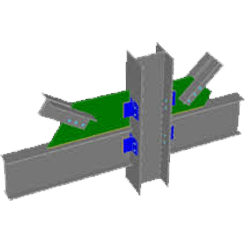




SeismoStruct 2025.1 is a specialized structural analysis software developed by Seismosoft. It is designed for performing advanced nonlinear static and dynamic analyses of structures, with a particular emphasis on seismic performance evaluation. This software is a critical tool for civil and seismic engineers engaged in designing and assessing structures subjected to earthquake loads. SeismoStruct distinguishes itself through its capacity for precise inelastic analysis, enabling detailed damage assessment as mandated by modern seismic design codes.
SeismoStruct offers extensive support for modeling various structural systems and materials, facilitating comprehensive analysis. The software allows engineers to accurately represent the behavior of reinforced concrete elements, steel components, and fiber-reinforced polymers (FRP). This broad material support enables the simulation of complex structural behaviors under diverse loading conditions.
The software provides a suite of analytical techniques essential for seismic engineering. Structural engineers can perform linear and nonlinear static analyses, essential for understanding fundamental load-displacement relationships. Dynamic analyses, including modal analysis and time-history analysis, are central to evaluating structural response to transient loads like earthquakes. SeismoStruct also supports advanced methods such as Incremental Dynamic Analysis (IDA) and pushover analysis, allowing for a detailed assessment of structural capacity and vulnerability under seismic events.
SeismoStruct is designed to integrate within a broader engineering workflow. It supports the import of geometrical data from external sources, facilitating the transfer of models created in common CAD software. This interoperability ensures that engineers can leverage existing design files and focus on the detailed structural analysis for which SeismoStruct is intended. While specific interoperability protocols may vary, the import functionality streamlines the analytical process.
SeismoStruct has been applied to the analysis of critical infrastructure and complex building projects, where accurate seismic performance evaluation is paramount. For instance, its capabilities are utilized in assessing the seismic resilience of bridges, high-rise buildings, and industrial facilities. The software’s detailed inelastic analysis helps engineers identify potential failure points and optimize designs to meet stringent seismic safety requirements, as demonstrated in various structural retrofitting and new construction projects.
SeismoStruct is capable of modeling both regular and irregular two- or three-dimensional structures. This includes a wide range of structural types that can be subjected to various static and dynamic loads, making it suitable for assessing the seismic performance of complex engineering designs.
SeismoStruct is distinctive due to its capability to perform inelastic analysis and model the spread of inelasticity, which allows for accurate damage estimation in seismic events. Compared to other software, it may have unique algorithms and methods, such as the adaptive push-pull method, which updates lateral load distributions dynamically.
SeismoStruct can integrate with standard CAD programs by allowing users to import geometrical models for analysis. Its compatibility with common file formats enhances its functionality as it merges modeling with detailed structural analysis.