
Synopsys QuantumATK is a comprehensive platform for atomistic simulations combining density functional theory (DFT), semi-empirical methods, and non-equilibrium Green’s function (NEGF) techniques. It enables predictive modeling of materials properties, electronic structure, and quantum transport from first principles. The platform bridges quantum-scale calculations with device-level simulations, making it essential for designing next-generation semiconductors, catalysts, batteries, and nanomaterials.
QuantumATK serves researchers and engineers at the atomic scale:
Materials Scientists discovering new 2D materials, alloys, and nanostructures
Semiconductor Researchers studying interfaces, defects, and novel channel materials
Nanotechnology Engineers designing transistors, memristors, and quantum devices
Computational Chemists investigating catalysis, surface reactions, and molecular electronics
Device Physicists simulating electronic and thermal transport at the nanoscale
Academic & National Lab Researchers in physics, chemistry, and materials science
Density Functional Theory (DFT): Full-featured DFT with advanced exchange-correlation functionals (LDA, GGA, meta-GGA, hybrid)
Non-Equilibrium Green’s Function (NEGF): Quantum transport for nanoscale devices including coherent and dissipative transport
Semi-Empirical Methods: DFTB (Density Functional Tight-Binding), extended Hückel for larger systems
Classical Force Fields: ReaxFF, Tersoff, Brenner for molecular dynamics of complex systems
Magnetic Materials: Spin-polarized DFT with non-collinear magnetism and Dzyaloshinskii-Moriya interactions
Optical Properties: Time-dependent DFT (TDDFT) for excitation spectra and dielectric functions
Thermal Transport: Phonon calculations, lattice thermal conductivity, and electron-phonon coupling
Electrochemistry: Implicit/explicit solvation models for catalysis and battery materials
Python Scripting: Full Python API for automated workflows and custom analysis
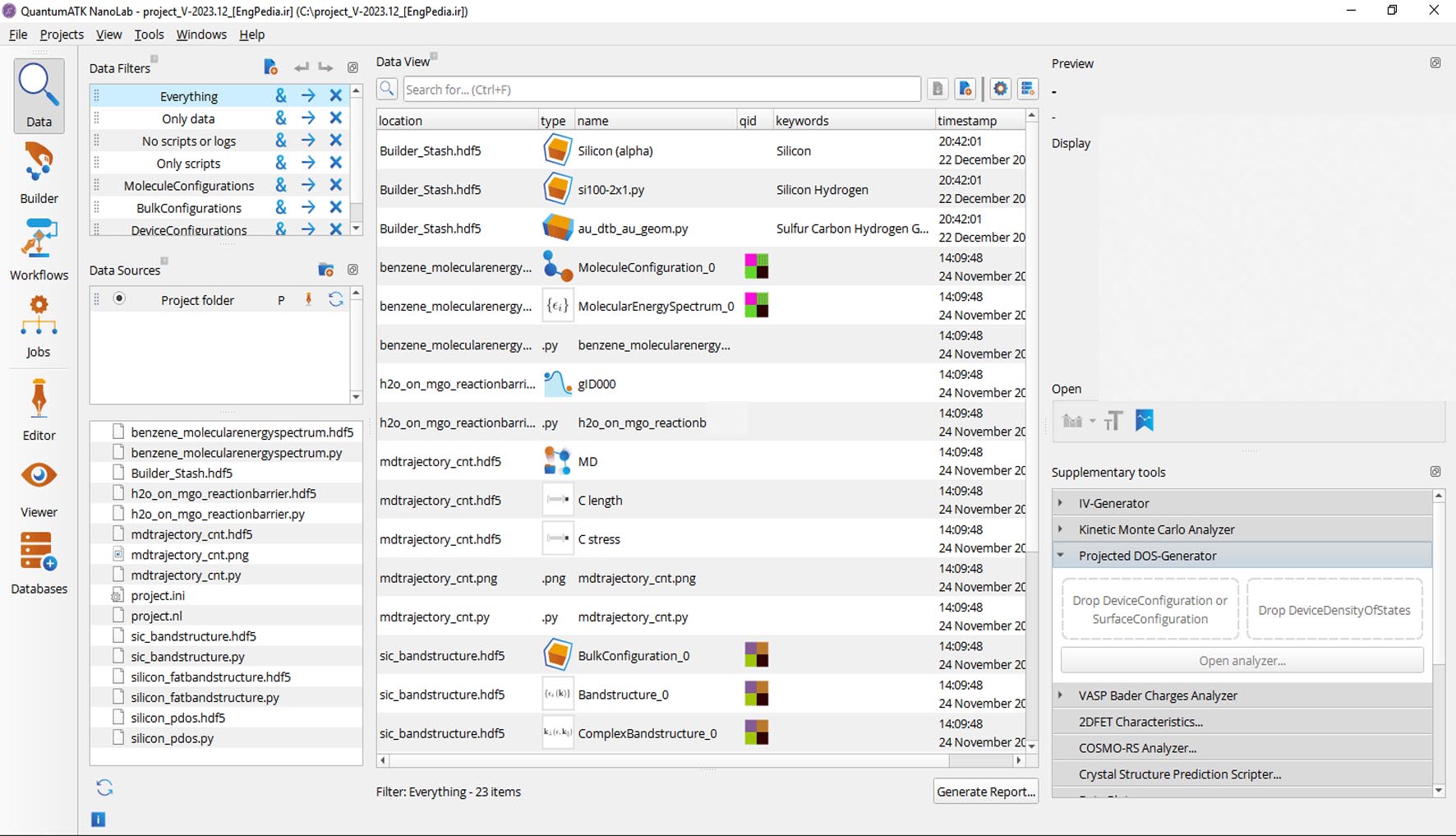
Graphical Interface: NanoLab GUI for setup, visualization, and analysis
Database Integration: Materials Project and other external database connectivity
High-Throughput Computing: Automated workflows for materials screening
Quantum Machine Learning (QML) Force Fields: AI/ML potentials trained on-the-fly during DFT calculations, enabling million-atom simulations with DFT accuracy
Quantum Computing Integration: Interface to quantum computers (IBM, Google) for selected quantum chemistry calculations
Exascale-Ready Algorithms: Enhanced scalability for Frontier and Aurora supercomputers (10,000+ GPUs)
Topological Materials Toolkit: Automated identification and characterization of topological insulators and semimetals
Strongly Correlated Systems: Dynamical mean-field theory (DMFT) integration for heavy fermion and Mott insulator systems
Superconductivity: Migdal-Eliashberg theory for conventional superconductors
Spin-Orbitronics: Advanced spin-orbit coupling models for spin-charge conversion devices
Radiation Effects: Displacement damage and ion implantation simulations
NVIDIA Grace Hopper Support: Optimized for GH200 superchips with unified CPU-GPU memory
Federated Learning: Collaborative model training across institutions while preserving data privacy
Automated Workflow Discovery: AI suggests optimal simulation protocols based on target properties
Real-Time Collaboration: Shared simulation sessions with interactive visualization
Minimum Requirements:
OS: RHEL 8.8, Rocky Linux 8.8, Ubuntu 22.04 LTS
CPU: Intel Xeon Gold 6326 or AMD EPYC 7313 (32 cores minimum)
RAM: 128 GB (256 GB recommended for NEGF transport)
GPU: NVIDIA A100 (40/80 GB) or H100 for GPU acceleration
Storage: 500 GB NVMe SSD + 2 TB for scratch files
MPI: OpenMPI 4.1+ or Intel MPI
Recommended HPC Configuration:
OS: RHEL 9.2, SLES 15 SP4 HPC
CPU: 4× AMD EPYC 9754 (512 cores total) or Intel Xeon Platinum 8592+
RAM: 1-4 TB per node (for large DFTB/MD simulations)
GPU: 8× NVIDIA H100 (640 GB total) or 4× GH200
Storage: All-flash parallel file system (Lustre/DAOS) with 100+ TB
Interconnect: NVIDIA Quantum-2 InfiniBand (400 Gb/s)
Supported Configuration:
OS: Windows 10/11 Pro 64-bit
CPU: Intel Core i9-14900K or AMD Ryzen 9 7950X
RAM: 128 GB minimum (256 GB recommended)
GPU: NVIDIA RTX 4090 (24 GB VRAM) for visualization
Storage: 1 TB NVMe SSD
Note: Full calculations should be submitted to Linux servers
Price: 325 $
Price Currency: $
Operating System: Windows
Application Category: Computational Chemistry












Reviews
There are no reviews yet.