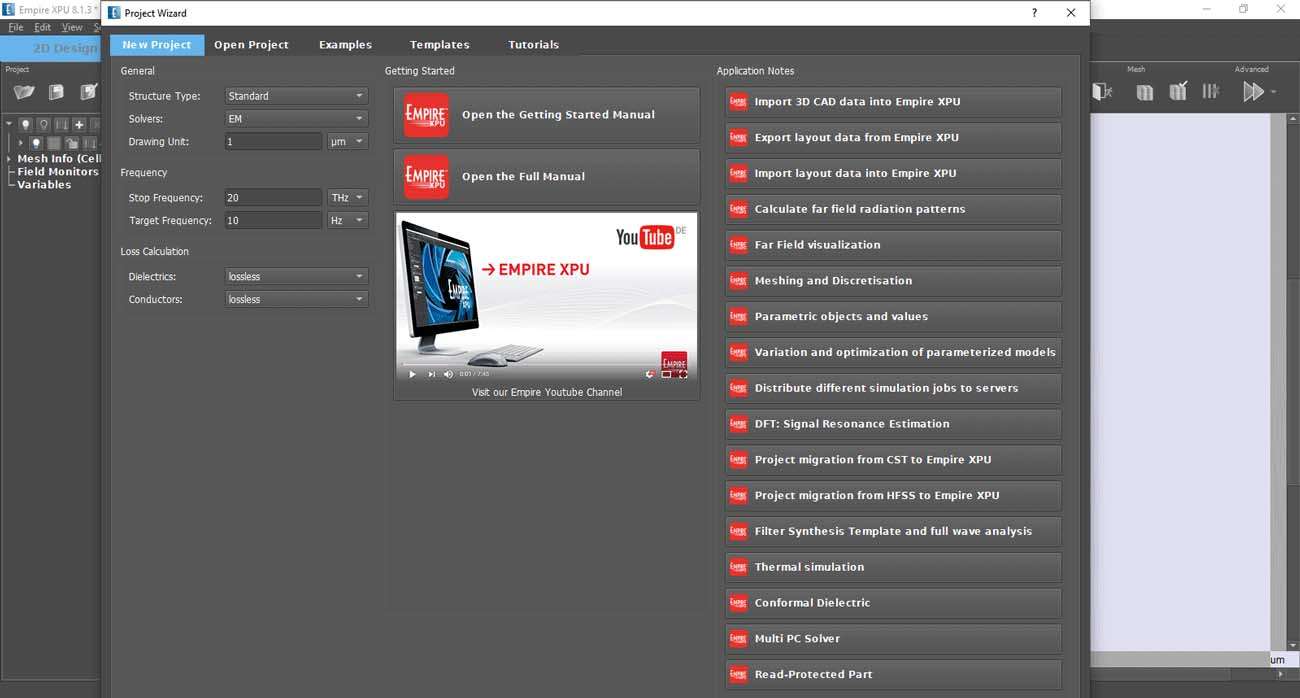
EMPIRE XPU is a 3D time-domain electromagnetic modeling tool for antennas, microwave circuits, and electromagnetic chip design. The software is based on the powerful Finite Difference Time Domain (FDTD) method, which is recognized as the industry standard for the design of RF and microwave components and antennas. The software uses XPU acceleration technology, which allows for very heavy calculations to be performed at impressive speeds. Due to the use of advanced computational architecture, EMPIRE XPU has a prominent position in the fields of waveguide, antenna, resonance, and microwave circuit design.
-
Electromagnetic analysis using the FDTD (Finite Difference Time Domain) method : Using an advanced numerical method to solve Maxwell’s equations with very high accuracy and the ability to examine the phenomena of propagation, interference, and reflection in complex environments.
-
XPU Acceleration : Leverages CPU and GPU parallel processing to reduce simulation time on large and complex models.
-
3D Geometric Modeling : Ability to define complex CAD models with a graphical user interface and advanced tools for designing antenna and RF structures.
-
High Frequency Simulation : Suitable for analyzing millimeter wave structures, high gain antennas, filters, and microwave components.
-
Automated Optimization Support : Ability to define design parameters and execute optimization algorithms to achieve desired performance.
-
Advanced Visualization : Provides a three-dimensional display of electric and magnetic fields, power distribution, and reflection and transmission coefficients.
-
Support for complex materials (Complex Material Modeling) : Simulate the behavior of heterogeneous, dielectric, ferromagnetic materials and multilayer structures in real conditions.
-
Integration with external design tools (External CAD Integration) : Ability to import CAD models from other software for fast and accurate analysis.
-
S-Parameter Analysis : Extraction of reflection and transmission coefficients to investigate RF performance and high-speed communications.
-
Support for multi-node parallel processing (Cluster Computing) : Run heavy calculations on computing clusters to increase the scale and speed of analysis.
Applications
-
Design and analysis of high-gain array antennas in radar and telecommunications systems.
-
Modeling and optimization of filters, resonators, and waveguides in high-frequency applications.
-
Analysis of electromagnetic phenomena in military and space projects requiring high accuracy.
-
Design of RF structures for medical equipment and non-invasive imaging.
-
Development of next-generation 5G and 6G technologies with a focus on high-frequency infrastructure.
Application of this software in MEMS
This software plays a very important role in the field of microelectromechanical systems (MEMS) and can be used in the design, analysis, and optimization of these systems. MEMS are considered as systems with microscopic dimensions that combine mechanical, electromagnetic, and electronic functions. In the following, some applications of EMPIRE XPU in the field of MEMS will be discussed:
- Sensor and Actuator Design and Simulation: EMPIRE XPU enables the simulation and design of MEMS sensors and actuators. Using advanced numerical algorithms, this software can model the electromagnetic and mechanical fields in these components and examine their performance.
- Dynamic Behavior Simulation: MEMS often have complex dynamic behavior that requires accurate simulation. EMPIRE XPU enables simulation of the dynamic behavior of these systems using advanced models.
- Simulate Electromagnetic Field Variations: In many MEMS, electromagnetic field variations play a critical role in their performance. EMPIRE XPU is able to simulate these variations and analyze their effect on the system.
- Architectural Systems Design: Using this software, you can design and optimize MEMS architectural systems. This software allows you to analyze the risks and benefits of various architectural designs.
- Biomechanical Sensor Design: MEMS are also used in the field of biomechanical sensors. This software can help in the design and optimization of these sensors and examine their performance.








Reviews
There are no reviews yet.