
Silvaco TCAD is a comprehensive suite of software tools for simulating the fabrication (process simulation) and electrical/optical behavior (device simulation) of semiconductor components. It solves fundamental physics equations (Poisson, drift-diffusion, quantum transport) to predict how a semiconductor device will behave based on its physical structure and material properties. Unlike circuit simulation (SPICE), which uses compact models, TCAD simulates from “first principles,” making it essential for developing new semiconductor technologies, optimizing existing ones, and gaining deep physical insight without costly and time-consuming wafer fabrication.
Silvaco TCAD is a specialized, high-end tool for semiconductor technology development:
Process Integration Engineers simulating fabrication steps (implantation, diffusion, etching, deposition).
Device Physicists & Engineers designing and characterizing transistors (CMOS, FinFET, GAA, HEMT, Power), diodes, and memories.
TCAD Modeling Specialists calibrating physical models to silicon data for predictive simulation.
R&D Scientists in academia and national labs exploring novel materials (2D, oxides) and device architectures.
Failure Analysis Engineers using simulation to root-cause yield and reliability issues.
EDA & PDK Developers generating process design kits and compact models for circuit design.
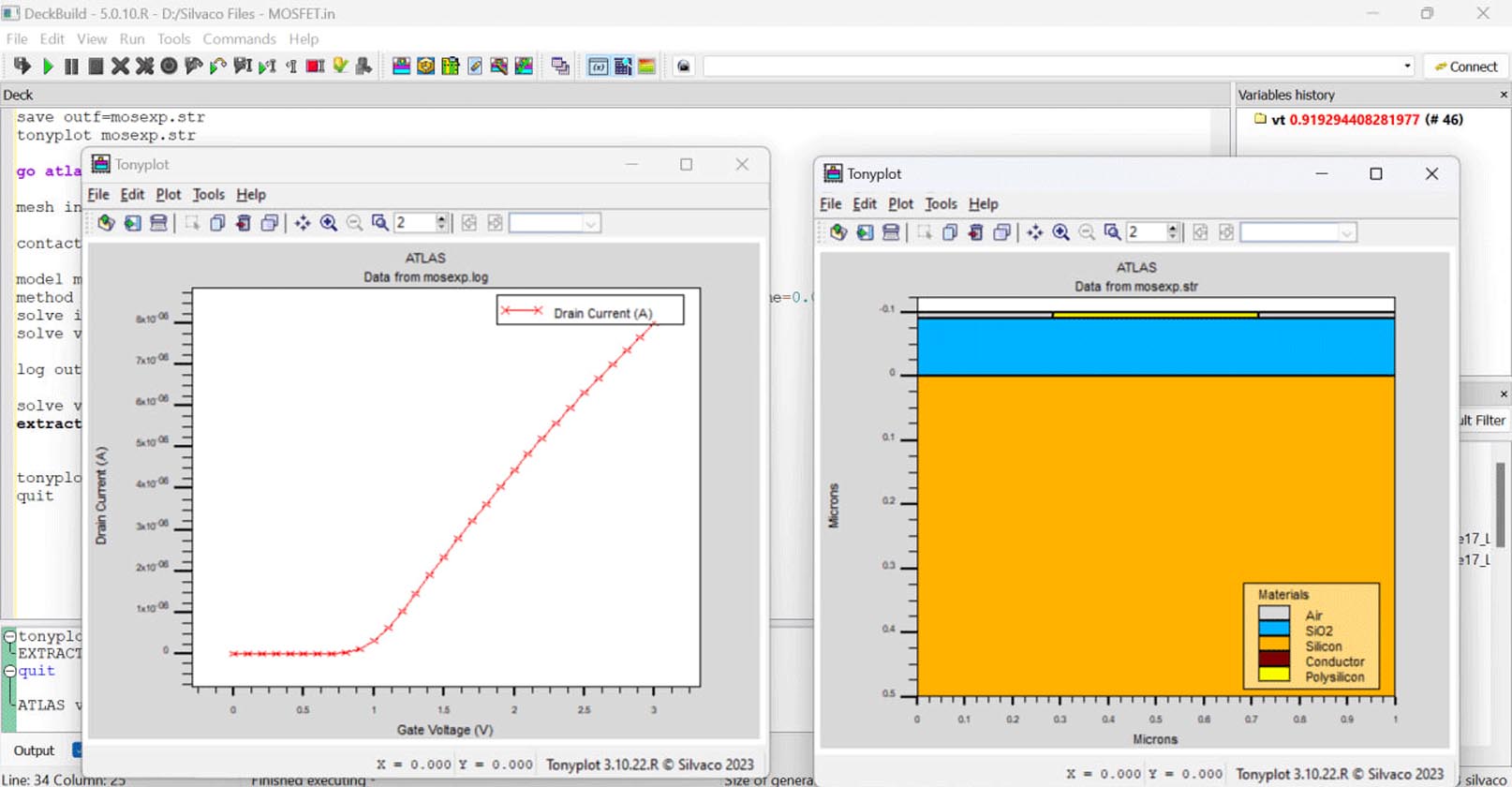
Process Simulation (Victory Process): Simulates semiconductor manufacturing steps:
Implantation & Diffusion: Using Monte Carlo ion implant (MC Implant) and advanced diffusion models.
Etching & Deposition: Feature-scale topography simulation (CMP, RIE, PVD, CVD, ALD).
Lithography & OPC: Basic lithography simulation capabilities.
Device Simulation (Victory Device): State-of-the-art 2D/3D device electrical and optical simulation:
Advanced Transport Models: Drift-diffusion, hydrodynamic, Monte Carlo, and quantum-corrected models.
Advanced Materials: Support for Si, SiGe, III-Vs (GaAs, GaN), 2D materials (graphene, TMDs), wide-bandgap semiconductors (SiC).
Transient & AC Analysis: For switching, RF, and noise characteristics.
Optoelectronic Simulation: For LEDs, lasers, photodetectors (Victory Device Light).
Interconnect & Reliability (Victory Interconnect & Reliability): Simulate electromigration, TDDB, and thermal effects in backend metal lines.
Lithography & DFM (Athena L-Edit): Mask layout, design rule checking, and basic DFM analysis.
GUI & Visualization (DeckBuild, TonyPlot, MaskViews):
DeckBuild: The central graphical input deck builder and job manager for Linux.
TonyPlot: Powerful 1D/2D/3D data visualizer for simulation results.
Calibration & Optimization (Workbench): GUI environment for DOE, optimization, and model calibration to experimental data.
The 2024 release focuses on advanced nodes, heterogeneous integration, and AI/ML acceleration:
GAA Nanosheet & CFET Support: Enhanced process and device simulation flows for next-generation transistors beyond FinFET, including detailed quantum confinement models for stacked nanosheets and complementary FET (CFET) architectures.
3D Heterogeneous Integration (3DHI): New tools for simulating hybrid bonding, through-silicon vias (TSVs), and thermal-mechanical stress in 3D-stacked and chiplets-based designs.
AI/ML Enhanced Calibration (SmartSpice AI Integration): New framework using machine learning to dramatically accelerate the calibration of TCAD models to electrical test data, reducing setup time from weeks to days.
Advanced Power Device Models: Enhanced physical models for high-voltage GaN HEMTs (p-Gate, MIS-HEMT), SiC MOSFETs, and superjunction devices, including trap dynamics and reliability (BTI, HCI).
Cloud-Native Execution & Licensing: Improved support for submitting large-scale 3D simulations to cloud HPC resources (AWS, Azure) directly from the desktop GUI, with flexible cloud-based licensing options.
Performance & Scalability: Upgraded solvers leveraging AVX-512 instructions and improved MPI parallelization for faster 3D device simulations on large-core-count servers.
OS: Red Hat Enterprise Linux 7.9, CentOS 7.9, Rocky Linux 8.8
CPU: Intel Xeon E5-2600 v4 or AMD EPYC 7002 series (8 cores)
RAM: 32 GB
GPU: Not required for core simulation (OpenGL-capable GPU for TonyPlot visualization)
Storage: 100 GB free space on fast local storage (SSD)
Network: Gigabit Ethernet for license server access
OS: RHEL 8.8/9.2, Rocky Linux 9.2, AlmaLinux 9.2 (Latest stable kernels with updated glibc)
CPU: Dual AMD EPYC 9654 (96 cores each) or Intel Xeon Platinum 8490H (60 cores each). High core count & memory bandwidth are critical.
RAM: 512 GB – 2 TB (3D process/device simulation is extremely memory intensive)
GPU: Optional but beneficial: NVIDIA A100/H100 for ML-based workflows; Professional GPU (RTX A6000) for advanced 3D visualization.
Storage: Tiered Storage is essential:
Scratch: 2+ TB NVMe SSD (PCIe 4.0/5.0) for temporary solver files.
Project/Data: 10+ TB high-performance parallel file system (Lustre, GPFS) or NAS.
Network: 10 GbE minimum; InfiniBand for multi-node HPC clusters.
License Server: A dedicated server for FlexNet daemon (often on a separate machine).
Compatible Compilers: GNU gcc/g++ (typically 8.3-11.2), Intel Compilers (optional).
System Libraries: glibc 2.17+, specific versions of libpng, libjpeg, Motif/Lesstif.
MPI: OpenMPI or Intel MPI for parallel execution.
X11 Forwarding: Required for GUI (DeckBuild, TonyPlot) when connecting remotely.
Price: 325 $
Price Currency: $
Operating System: Windows
Application Category: Electronics







Reviews
There are no reviews yet.