
Synopsys Photonic Solutions 2024.09 is the world’s leading Photonic Design Automation (PDA) platform, providing a complete, end-to-end workflow for designing, simulating, and fabricating integrated photonic circuits. It combines the industry-standard tools RSoft (component simulation) and Phoenix Software (layout and verification) under the Synopsys ecosystem. This unified platform addresses the unique challenges of photonic design—where light, electronics, and thermal effects interact—bridging the gap between component-level physics and system-level performance for applications in data centers, telecommunications, healthcare, and automotive.
SPS is the industry-standard platform for professional integrated photonics:
Photonic IC (PIC) Designers designing silicon photonics, InP, and TriPleX-based circuits for datacom, telecom, sensing, and LiDAR.
R&D Scientists & Academics in universities and national labs pushing the boundaries of integrated photonics and quantum optics.
Optical System Architects modeling and simulating complex coherent transceivers, optical compute, and sensor systems.
Foundry Process & PDK Engineers at silicon photonics fabs (e.g., GlobalFoundries, Tower Semiconductor, IMEC) developing process design kits.
Packaging & Integration Engineers designing fiber coupling, interposers, and co-packaged optics.
Product Engineers bringing photonic systems from lab to high-volume manufacturing.
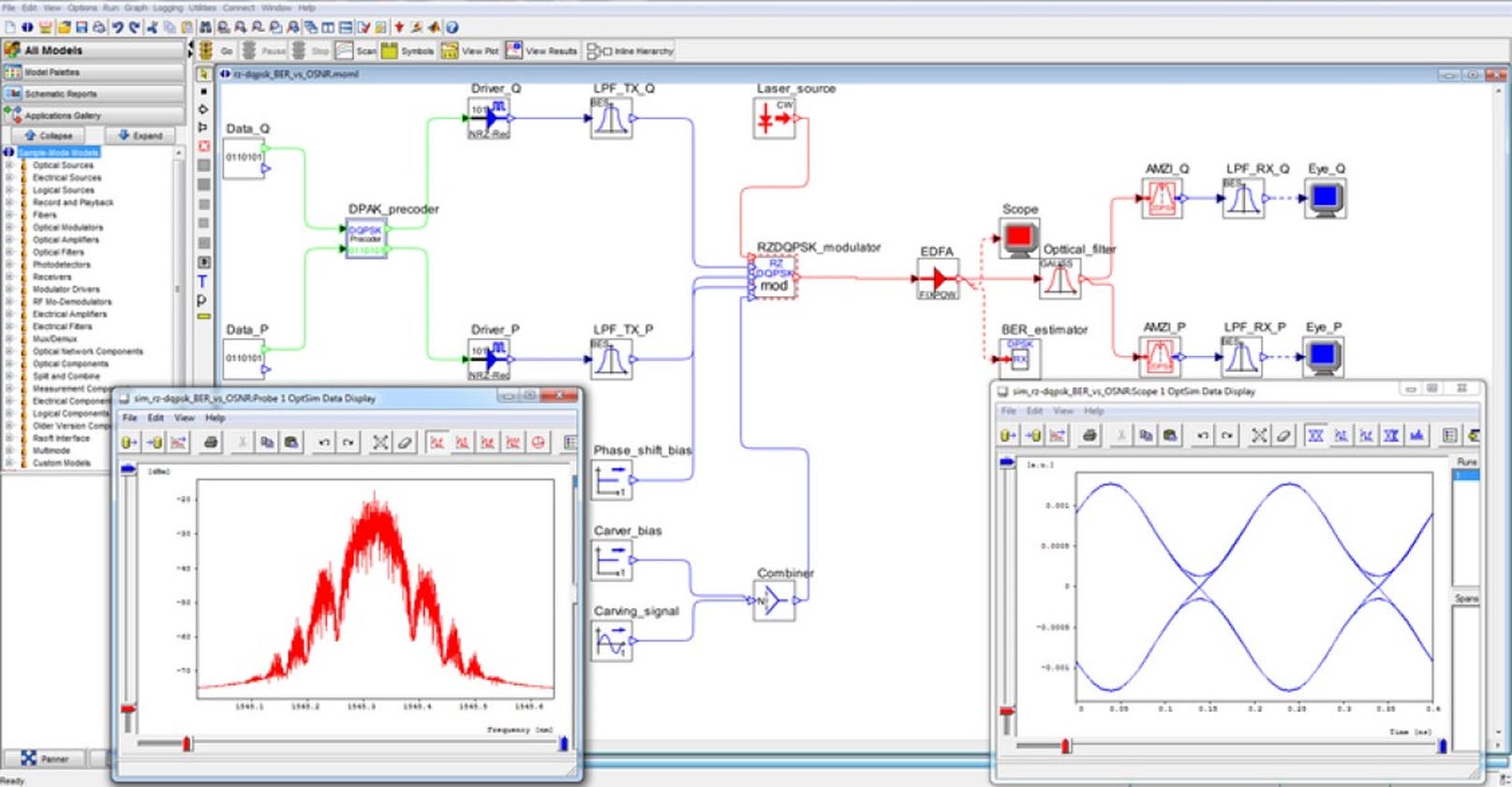
Component Simulation (RSoft):
FullWAVE FDTD: 2D/3D Finite-Difference Time-Domain solver for rigorous simulation of waveguides, couplers, gratings, and metasurfaces.
BeamPROP & BandSOLVE: Beam propagation and eigenmode solvers for simulating long propagation paths and calculating photonic band structures.
LaserMOD & LEDMOD: Specialized tools for simulating active devices (lasers, LEDs, SOAs).
Circuit & System Simulation (INTERCONNECT): Hierarchical, multi-domain circuit simulator that connects photonic, electronic, and thermal models. Includes extensive libraries of verified components and laser models.
Layout & Physical Design (Phoenix Photonic Layout): Dedicated layout editor for PICs with:
Parameterized Photonic Components (PPCs): Dynamic cells that adapt to process rules.
Photonic-Aware DRC & LVS: Rule checking specific to curvilinear shapes, waveguide spacing, and phase-matching requirements.
Automatic Port & Edge Coupler Generation.
Multi-Physics Analysis: Electro-optical (EO) and thermo-optical (TO) co-simulation to model phase shifters, modulators, and thermal crosstalk.
Process Variation & Yield Analysis (CODE V Integration): Monte Carlo analysis with measured process variations from fabs to predict manufacturing yield.
Optical Fiber & Packaging: Tools for simulating edge and grating couplers, and designing packaging interfaces.
Synopsys Ecosystem Integration: Direct links to Synopsys PrimeSim for SPICE-level electronic co-simulation, OptoDesigner for schematic-driven layout, and Silicon Smart for characterization.
The 2024.09 release emphasizes AI-driven design, heterogeneous integration, and quantum photonics:
AI-Powered Photonic Inverse Design (OptoCompiler AI): New module using generative AI and adjoint optimization to automatically generate optimal photonic component geometries (e.g., splitters, bends, filters) meeting specified performance targets (size, bandwidth, loss), reducing design time from weeks to hours.
3D Heterogeneous Integration (3DHI) Workflow: Enhanced support for co-designing photonics with electronic interposers, including thermal and stress analysis for CPO (Co-Packaged Optics) and optical I/O chiplets.
Quantum Photonics Design Kit (QPDK): New libraries and simulation models for designing integrated photonic circuits for quantum computing, sensing, and communications, including single-photon sources, detectors, and linear optical networks.
Cloud-Native Simulation Jobs: Expanded integration with Synopsys Cloud for elastic scaling of compute-intensive FDTD and parameter sweeps, with automated job submission and result management.
Enhanced Foundry PDK Support: Updated support for the latest PDKs from major foundries (GF Fotonix, AIM Photonics, TSMC) including new process design rules and compact models for advanced nodes.
Usability & Performance: 30% faster FDTD solver performance with GPU acceleration (NVIDIA CUDA) and a streamlined UI for setting up complex system-level simulations in INTERCONNECT.
Minimum Requirements:
OS: RHEL 8.6+, Rocky Linux 8.8+, Ubuntu 20.04 LTS+
CPU: Intel Xeon Silver 4310 or AMD EPYC 7313 (16 cores minimum)
RAM: 128 GB (256 GB recommended for 3D FDTD)
GPU: NVIDIA RTX A5000/A6000 or equivalent (24+ GB VRAM)
Storage: 1 TB NVMe SSD + 10 TB shared storage
Network: 10 GbE minimum, InfiniBand for HPC clusters
Recommended (Enterprise Deployment):
OS: RHEL 9.2, Rocky Linux 9.2
CPU: Dual AMD EPYC 9684X or Intel Xeon Platinum 8592+ (96+ cores)
RAM: 512 GB – 2 TB
GPU: NVIDIA H100 (80 GB) for AI/ML workloads
Storage: All-flash parallel file system (100+ TB)
HPC: SLURM/LSF integration for job scheduling
Supported Configuration:
OS: Windows 10/11 Pro/Enterprise (64-bit)
CPU: Intel Core i9-14900K or AMD Ryzen 9 7950X (24+ threads)
RAM: 128 GB minimum
GPU: NVIDIA RTX 4090 or RTX A6000 (24+ GB VRAM)
Storage: 2 TB NVMe SSD
Note: Windows support is primarily for OptoDesigner, INTERCONNECT, and layout tools. Heavy FDTD simulation should be run on Linux servers or cloud.
Price: 325 $
Price Currency: $
Operating System: Windows
Application Category: Optics










Reviews
There are no reviews yet.