HampsonRussell Geoview 2026.0
Available versions: 2025.2 , 2024.3 , 2024.2 , 13.2 , 13.1 , 13.0 , 12.2 , 12.0 , 11.0.3.1 , 11.0 , 10.6 , 10.5 win , 10.5 linux , 10.4.2 , 10.4.1

HampsonRussell software products have been providing innovative geophysical solutions since 1987, in comprehensive and easy-to-use packages.
Why Choose HampsonRussell
Reduce the risks and costs associated with exploration and production with world-class advanced geophysical interpretation and analysis from our HampsonRussell software.
This comprehensive suite of reservoir characterization tools integrates well logs, seismic data and geophysical processes into an easily navigated, intuitive package for fast results. Known for its ease of use, HampsonRussell makes sophisticated geophysical techniques accessible.
-
- circle
Experience powerful speed improvements for your processing projects with multi-node processing
- circle
Get the flexibility to design and code any process with the Python ecosystem while taking advantage of the HampsonRussell project structure and data access
- circle
Quickly import and use shapefiles
- circle
Work with your AWS and Microsoft Azure cloud data
HampsonRussell offers a comprehensive suite of reservoir characterization software tools:
GeoAI encompasses a novel methodology for seismic reservoir characterization with limited well control, speeding up reservoir property predictions with a rock physics driven machine learning technique. Rock Physics theory and statistical simulations generate synthetic data for various geological scenarios. A simplified machine learning approach employs Convolutional Neural Networks (CNN) estimating multiple rock property volumes in a greatly simplified workflow.
Benefits of GeoAI:
- Improves Reservoir Characterization for low well-control areas
- Allows direct prediction of facies and reservoir properties
- Utilizes rock physics guided machine learning to optimize extraction of information and value addition from all available data
In standard supervised machine learning approaches, the seismic-to-rock property relationship is learned using available data. These methods, particularly deep learning, depend on having enough labeled data to adequately train the neural network. WellGen overcomes this challenge by generating synthetic data, simulating many pseudo-wells based on existing well statistics and rock physics modeling.
WellGen addresses common machine learning challenges, including:
- Scarcity of wells within the study area
- The difficulty of tying well data with seismic
- High variability in the well curves not depicting geological variations
- Inability to link geological and geophysical observations
- Reservoir complexity that cannot be resolved by inversion alone
AVO is a comprehensive HampsonRussell module for pre-stack data conditioning, attribute computation and analysis. This module has the tools for conditioning pre-stack seismic data to produce optimum attribute volumes, cross-plotting and interpretation functions for locating AVO anomalies, and AVO modeling tools for calibration. Customizable workflows and the integration of AVO tools into the Geoview interface make sophisticated AVO analysis simple.
Benefits of HampsonRussell AVO:
- Provides a single comprehensive module for data conditioning, attribute calculation and analysis
- High-grades pre-stack seismic data for inversions
- Calibrates seismic data with model data
- Enables simple navigation and comparison of multiple attribute volumes with seismic gathers
Strata performs both post-stack and pre-stack inversions. In the conventional post-stack domain, Strata analyzes post-stack seismic volumes to produce an acoustic impedance volume. In the pre-stack domain, Strata analyzes angle gathers or angle stacks to produce volumes of acoustic impedance, shear impedance and density.
Benefits of Strata:
- Provides easy QC and inversion parameter optimization at well locations using inversion analysis
- Enables access to multiple inversion techniques such as model-based, colored and sparse spike inversion algorithms
- Produces elastic attribute volumes as outputs which are ideally suited to be used as inputs for Emerge attribute prediction, or LithoSI facies classification
Emerge is a geostatistical, attribute prediction module that can predict property volumes using well logs and attributes from seismic data. The predicted properties can be any log types available, such as porosity, velocity, density, gamma-ray, lithology and water saturation. Emerge can also be used to predict missing logs or parts of logs by using existing logs that are common to the available wells with deep learning and deep-feed neural network (DFNN) techniques.
Benefits of Emerge:
- Enables non-linear, high-resolution predictions using neural networks
- Gives the ability to predict volumes of any data type
- Allows all data to be used during training through internal cross-validation
- Derives a measure of correlation and error at each well used in the training
- Enhances prediction of missing log data by using multi-log and non-linear combinations
GeoSI is a geostatistical (single stack and multiple stack) inversion application that generates high-frequency stochastic models for high-resolution reservoir characterization and uncertainty analysis. It addresses the band-limited nature of deterministic inversion methods and integrates well data and seismic data at a fine scale within a stratigraphic geomodel framework.
Benefits of GeoSI:
- Provides increased resolution integrating well and seismic data
- Supports cascaded reservoir property simulation
- Enables risk and uncertainty analysis using probability cubes
- Facilitates interpretation and reservoir simulation by using a stratigraphic framework
More:
- HampsonRussell ProAZ – ProAZ maps fractures and predicts stress by observing azimuthal variations in the P-wave seismic data. It provides a series of tools to enable interpreters to interactively explore for azimuthal variations in their datasets and generate azimuthal attributes to summarize the results.
- HampsonRussell Multi-node Processing (MNP) – A utility that divides the processing of large seismic volumes into equal-sized segments, each segment using a different machine (node) in order to reduce the overall run time of the processing. It is most effective for heavy-computation tasks such as pre-stack inversion, where I/O limitations are not a bottleneck.
- HampsonRussell Attributes – The Attributes package is designed to create and extract a collection of advanced single- and multi-trace seismic attributes to enhance your interpreting ability to quantify the reservoir properties in seismic volumes as well as perform data preconditioning such as noise reduction and data quality control. Read more ->
- HampsonRussell LithoSI – LithoSI quantifies uncertainty in seismic lithology and fluid prediction. Using multiple elastic parameters from the inversion of seismic data, LithoSI performs a supervised Bayesian classification to deliver probability cubes of predicted lithology or rock properties. Read more ->
- HampsonRussell MapPredict – MapPredict is a map-based geostatistical software that integrates well, seismic, and attribute data into accurate, detailed maps using both sparse data measured at isolated wellbores and dense data measured on a survey grid. Read more ->
- HampsonRussell Pro4D – Pro4D performs time-lapse modeling and interpretation for seismic data matching. A range of anticipated reservoir scenarios can be modeled to predict the seismic response to reservoir changes. Read more ->
- HampsonRussell ProMC – ProMC is an easy-to-use and intuitive work environment that offers interpreters the ability to handle the increased number of seismic and attribute volumes inherent in a multicomponent project. It addresses the challenges of differences in event times, frequencies, and reflectivity between PP and PS seismic volumes.
- HampsonRussell Gather Conditioning – Gather Conditioning removes noise, provides consistent fold, time-aligns reflection events, and can be used to correct the background amplitude decay with offset calibrated using synthetic gathers generated from well logs. When input to processes such as AVO analysis, the conditioned gathers will result in more accurate and reliable results than the input of unconditioned gathers.
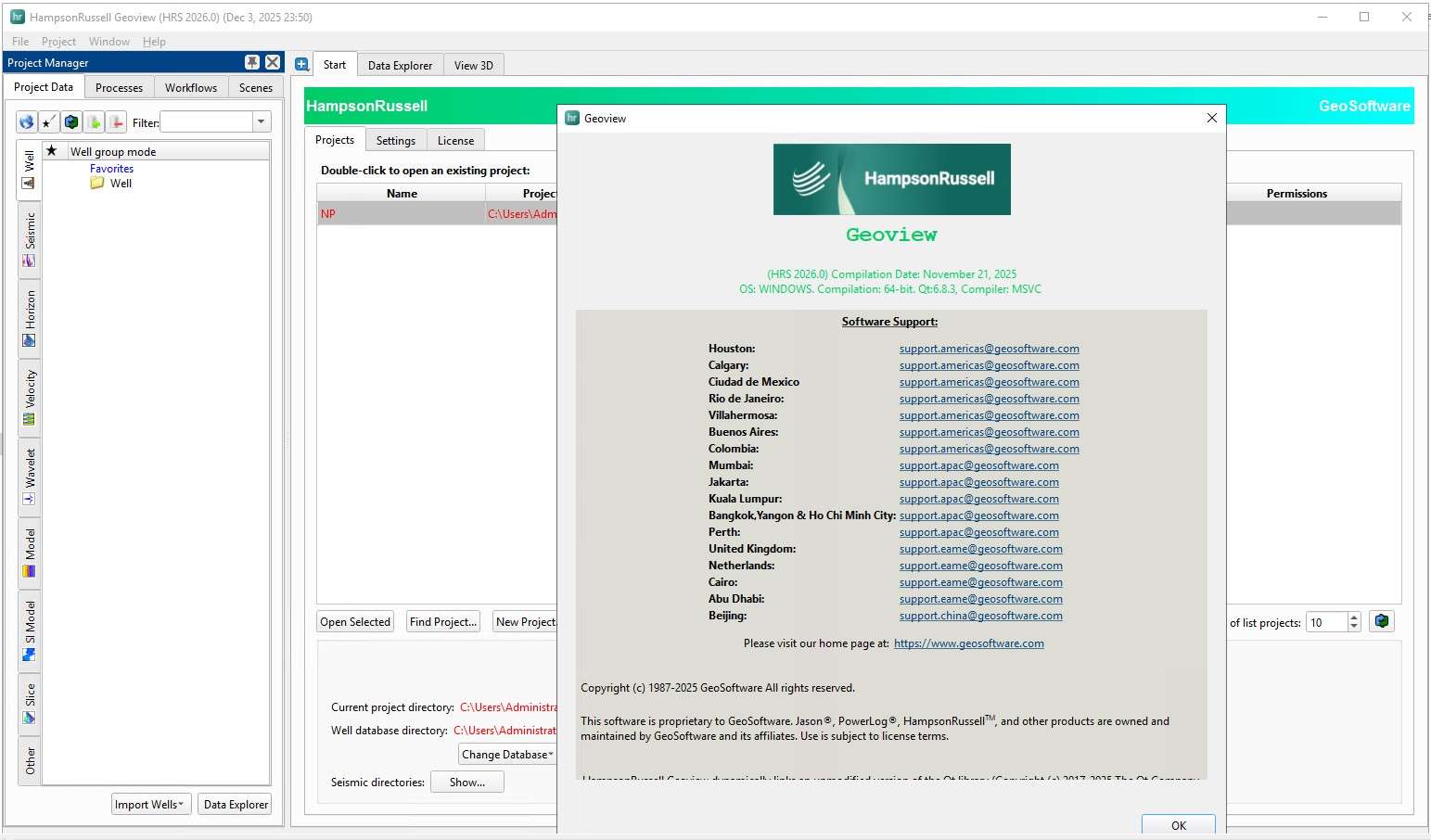
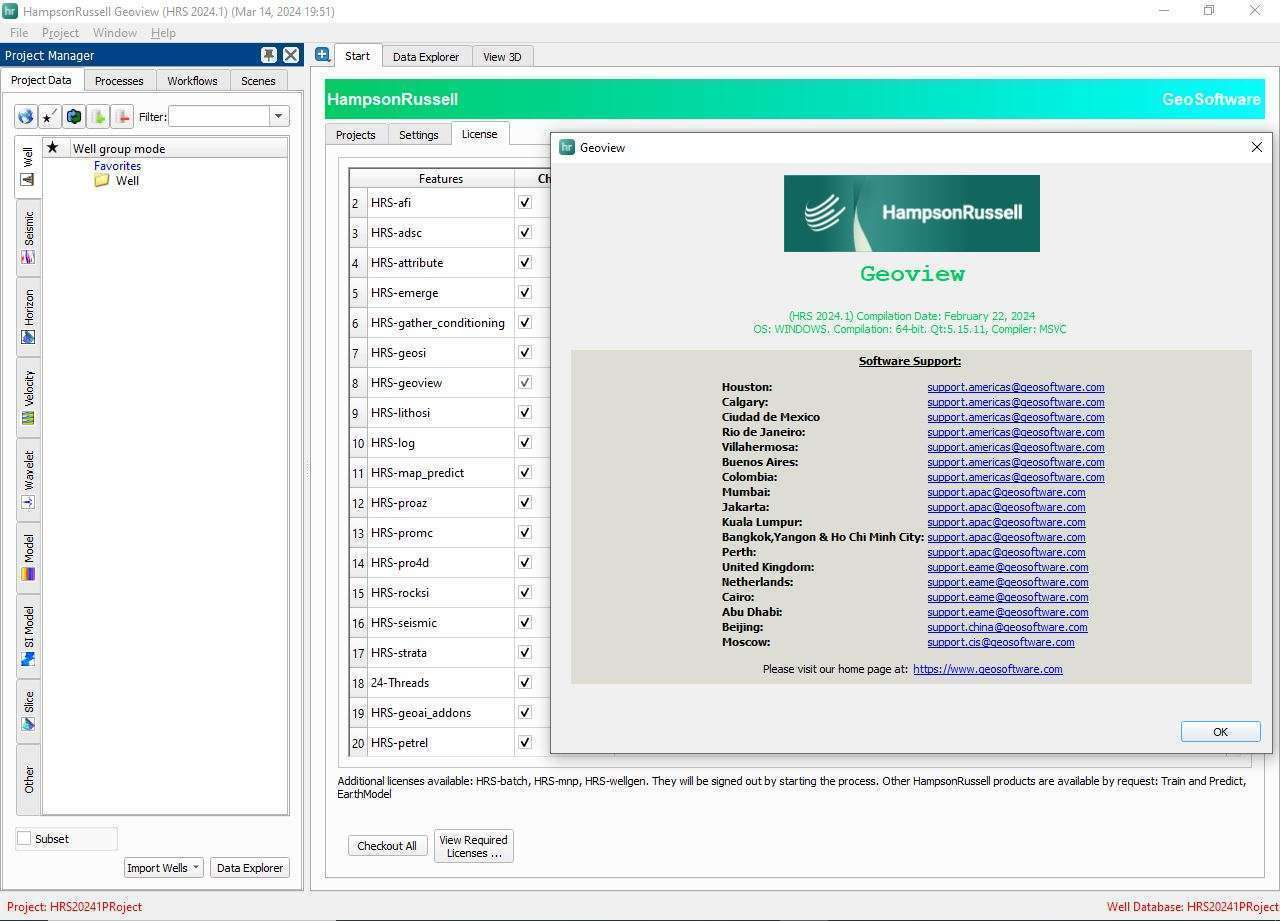
- HampsonRussell Geoview – Geoview is a single intuitive interface that allows users to access their project data and processes from one centralized location. Geoview also includes a set of pre-loaded process workflows that can be easily customized and shared with other users, as well as batch and chained processing tools for improved efficiency.
- HampsonRussell Advanced 3D Viewer – Advanced 3D Viewer is an add-on utility that offers enhanced 3D visualization and facilitates interactive display of results from HampsonRussell’s GeoSI, LithoSI, ProAZ, and Attributes packages.
Recent major new features for HampsonRussell
HampsonRussell 2024.0
Cross Plotting
Use curve groups to help manage and plot large well databases
Emerge
Apply trace mixing to laterally smooth the output volumes for the Dominant Frequency and Average Frequency attributes.
GeoAI
- Use GPU to speed CNN calculations such as the Training step .
- CNN Apply to Volume output can now be restricted to a time window between two horizons .
- Arbitrary line volumes (with 2D_XY geometry) can now be used as input in the CNN “Scale and Prepare Seismic” and “Apply at Well” steps .
- Angle dependent wavelet groups can now be used to generate synthetics and compute the scalar for the seismic in the Apply to Volume step .
- Quickly step through a series of wells in the “Apply at Well” step by specifying a Favorite Well list. Wells can be selected either using a favorites list or individually .
Log Processing
- Calculate and display the cumulative interval velocity in the Log Correlation process. Show the accumulated stretches in the Interval Velocity track .
- Use the Clip process to clip log amplitudes based on the deviation from the low-frequency trend of the curve. Select the new “Based on deviation from low frequency” option on the process parameters panel Parameters tab .
Seismic Processing
- When the AVO Attribute Volume process is part of a chained process, create a data slice of various AVO analysis type output, such as fluid stack, product, and scaled Poisson’s ratio .
- The QC tool in Chained Processing can now be run on seismic within a spatial zone .
Strata
- When building an Advanced Strata model, filter the logs before building the Strata model instead of using the Log Processingprocesses .
OpenWorks
- Import and export well data on Windows .
Petrel Connection
- Seismic data imported using the GeoSoftware Petrel Plugin can now be limited to data within a spatial zone .
Volume Attributes
- S Transform has been added as a Transform type option for the Spectral Decomposition Analysis process .
HampsonRussell 13.2
AVO
- AVO Gradient Analysis now handles mixed positive and negative offsets that exist in the input volume. In the Event Control panel, select whether to use absolute offsets or signed offsets in the AVO Analysis scene .
Seismic Processing
- The QC tool in Chained Processing can now be run on seismic within a spatial zone .
- Plot the amplitude spectrum for Chained Processes input or output .
- Create a data slice for Chained Processes input or output .
- Amplitude spectrum single click analysis location moves to new line .
GeoAI
- Simplified layout of WellGen and CNN windows .
- CNN Uncertainty Analysis assesses the performance of a trained Convolutional Neural Network (CNN) using a jackknife validation technique. .
MNP
- Use MNP locally without configuration steps .
Cross Plotting
- Hide zones in cross sections .
- Remove data points in a zone either by replacing their values using linear interpolation or with accepted nearby values .
RockSI
- View out of bounds rock parameters (potential nulls) and their replacement values .
HampsonRussell 13.1
Seismic Processing
- Simpler interface for Chained Processes .
GeoSI
- GeoSI run-time optimization (better defaults and documentation, .
ProMC
- Display PS traces using PP time in Inversion Analysis .
Fluid Replacement Modeling
Geoview
- Quickly view log settings for different wells when importing LAS files .
- Interactively define the correlation calculation window .
- Show previous correlation data incrementally including velocity changes .
- Log Correlation residuals track to QC the mismatch between the composite traces and synthetics .
- New shortcut keys for horizon picking actions .
GeoAI
- Switch between classic and advanced WellGen workflow .
- Jackknife validation for CNN Transfer Learning .
Petrel Link
- Import wells with known log types without opening all tabs .









Reviews
There are no reviews yet.